During PCST 2025, Indian science communicators discussed how science communication must move beyond simplifying research — toward equity, interdisciplinary engagement, and systemic change. The conference brought together a range of innovative formats and engaging dialogues to present a range of global perspectives. It also enabled Indian participants a chance to reflect on India’s emerging role in making science communication more equitable and community oriented.
What does science communication entail when it’s not just about simplifying complex research, but also about listening deeply, questioning power, and catalysing systemic change?
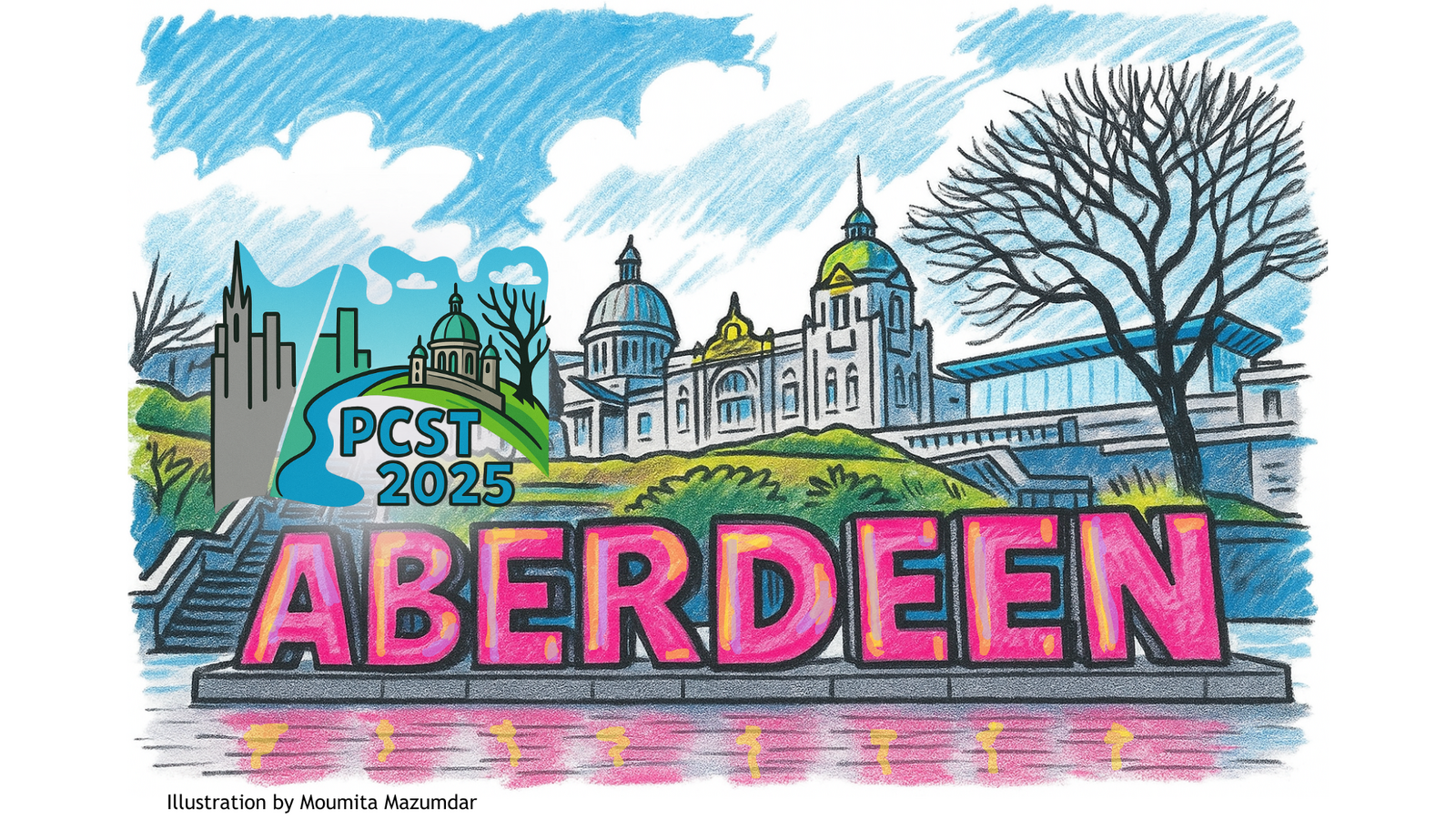
This is exactly what we gathered to collectively think about at the 17th International Public Communication of Science and Technology (PCST) Network Conference this May (2025) in Aberdeen, Scotland. Discussions exploring the “transitions, traditions and tensions” within science communication took centre stage — both explicitly during the conference sessions and in the interstitial spaces between talks, hallway conversations, and informal catch-ups over lunch and coffee.
As a returning participant and member of PCST’s Scientific Committee, I’ve seen this conference evolve over the years. This year’s edition was particularly noteworthy in terms of foregrounding values of equity, inclusion, and reflexivity not just in its content, but also in its structuring. Formats were redesigned to support creative and critical engagement, early-career and Global South voices were especially visible, and themes like co-creation, interdisciplinarity, and relationship-building took up real space.
Yet the process of learning and growth is never truly finished, and there’s a lot more work to do in ensuring wider accessibility, reducing barriers to participation for attendees from low- and middle-income countries (LMICs), and embedding these values more consistently across all tracks and formats. As with science communication itself, the conference reminded us that inclusion is not a checkbox — but a practice that must be carefully nurtured and continuously examined.
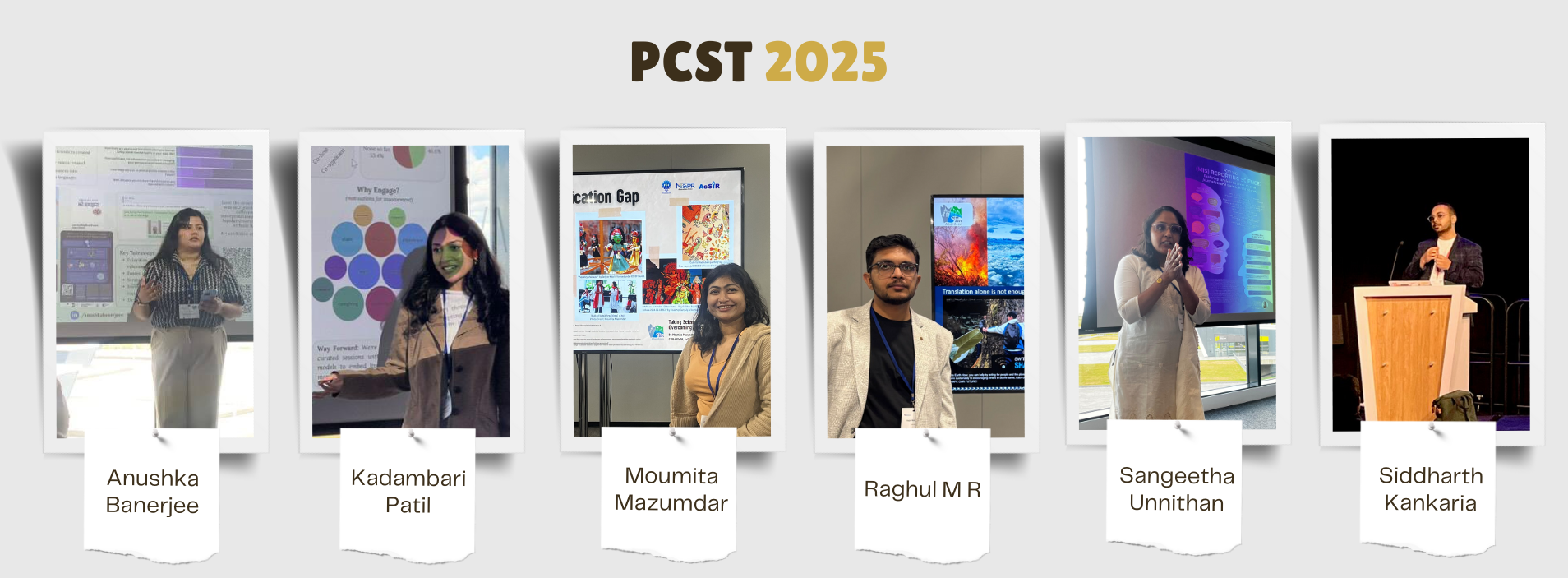
This ethos of continuous learning and reflexivity also resonated strongly with the Indian participants at PCST 2025. From PhD students and early-career researchers to independent practitioners, each attendee came with their own questions and left with new ideas, collaborators, and resolve.
Discovering common ground across disciplines
One overarching theme that many of us came back with was that science communication today is not — and cannot be — an isolated endeavour. It is inherently interdisciplinary, shaped by diverse knowledge systems including research, art, design, education, social sciences, media studies, and diverse lived experiences.
M. R. Raghul, whose PhD work sits at the intersection of climate and visual communication, described his PCST experience as “a constant loop of learning and unlearning.” Conversations with peers from Nigeria, Portugal, the Netherlands, Germany, and Ireland led to several unexpected conversations and exciting tangents — including a serendipitous moment where his interest in photogrammetry sparked new ideas for a researcher working on conserving museums and studying the possibilities of incorporating science within art museums.
A few dialogues are [still] continuing, which I hope will lead to successful research collaborations”
he shared.
Kadambari Patil, attending her first international SciComm conference, echoed a similar sentiment:
What started as small talk about the weather or the beautiful gardens near the University of Aberdeen often turned into meaningful discussions about the conference sessions and each other’s work”.
A particularly impactful conversation with Sophie Duncan encouraged her to seek mentorship to fortify her career in areas of public engagement and design-led communication, while other conversations inspired her to use evaluation and impact measurement approaches for strengthening her work projects. Overall, it made her feel like “there’s space for young science communicators like me to grow while doing what we love”.
Both Raghul and Kadambari also appreciated the space PCST created for creative formats — 3‑minute flash talks, medical animations, science theatre, photography, and creative storytelling approaches — which challenged traditional formats and expanded the boundaries of communicating science creatively.
Asking where India stands — and where we need to go
For many other attendees, PCST offered the dual opportunity to both reflect on India’s evolving SciComm ecosystem, and learn from global innovations, approaches, and initiatives as well.
For Moumita Mazumdar, attending PCST provided critical exposure to a global conference focused entirely on science communication.
What struck me most was the range of differing opinions, philosophies, and research methodology evident in science communication globally.”
It also made her reflect on how far India has come, but also how much more needs to be done in terms of embedding research, evaluation, and policy frameworks within science communication.
This sense of duality — progress and possibility — was echoed by Anushka Banerjee, whose work intertwines research on severe mental illnesses and science communication.
A lot of work that we’re doing in India is relevant and comparable to what’s being done globally”, but we don’t always know “how to parcel and present it in a comprehensive manner”.
She found the use of quotes, visuals, and community stories in posters and publications particularly refreshing. “I look forward to using the knowledge and skills I picked up at the conference to publish our work and facilitate collaborations” she added.
Anushka also appreciated “sessions focusing on making health communication more inclusive, especially when working with people with lived experience”. She also felt they were a timely reminder to “avoid using ableist terms, especially in [our] communications, to set better examples for the public” and how it was critical to build “communication strategies with — not just for — people with lived experiences”.
Rethinking institutional roles in media and public engagement
Sangeetha Unnithan, a science communication researcher and faculty at the Indian Institute of Management (IIM) Indore, found herself particularly reflecting on systemic differences across countries. “While we do have some very strong and well established science journalists in our country, science journalism still remains a niche field,” she said. But for her, “PCST opened the doors to understanding how science is prioritised and communicated in the rest of the world”. She particularly appreciated how committed scientific institutions were in countries like Germany and Ireland towards sharing their research through both traditional and digital media — something still rare in the Indian context.
She also valued the diverse tools and approaches being used within science communication globally, such as how “scholars from China were applying traditional theories in public opinion and psychology to study public engagement with modern scientific topics”. She also appreciated a session by Rachel Mason and James Piercy that advocated for “nurturing meaningful friendships — not merely partnerships — between researchers and science communicators to forge strong collaborations”.
For Sangeetha, the conference offered an important perspective reset:
Many times when we are super focused in our area of work, we lose sight of the larger cause or become completely oblivious to other perspectives. This gap is exactly what attending international conferences and events can bridge”.
Moving forward with purpose and possibility
Zooming out a bit, India’s science communication ecosystem is clearly at an inflection point. The past decade has witnessed remarkable creativity and growth, but significant gaps remain in building resilient infrastructures, funding frameworks, and sustainable career progression pathways. Embedding regional-language and community-led initiatives, investing in evaluation and impact measurement, and institutionalising DEIA and decolonial frameworks will all be critical in building a more robust and equitable future for the field.
Globally too, there’s a marked shift in the field — which is now moving away from one-directional, extractive, and performative outreach efforts and increasingly adopting more co-creation, collective meaning-making, and community-driven efforts. This evolution challenges us to reconsider not just how science is communicated, but also who it serves in our country — and who it truly benefits.
Hosting an international conference like PCST in India could perhaps help accelerate these changes and catalyse new developments for the field. For instance, an international science communication event in India would not only offer global visibility to Indian initiatives and practitioners, but also spotlight India’s unique contributions: linguistic plurality, grassroots innovation, and a strong social justice orientation. It could also help place Indian science communication more firmly on the global map — by allowing Indian approaches to shape international conversations, while also strengthening communities of practice locally. Moving towards this future could begin by more Indian representation at future conferences like PCST.
For now, PCST 2025 was a strong reminder that the future of science communication depends as much on introspection as on innovation. It requires us to slow down, reflect intentionally, and listen with care — not just to our audiences, but to each other as well.
Between practice and possibility lies the work we must keep doing — together.