At YIM 2023, Harinath Doodhi’s career took a surprising turn, from a chance encounter to a faculty position and his first funded grant in India. For him, YIM became more than a meeting; it was a launchpad for connections, mentorship, and understanding India’s research landscape.
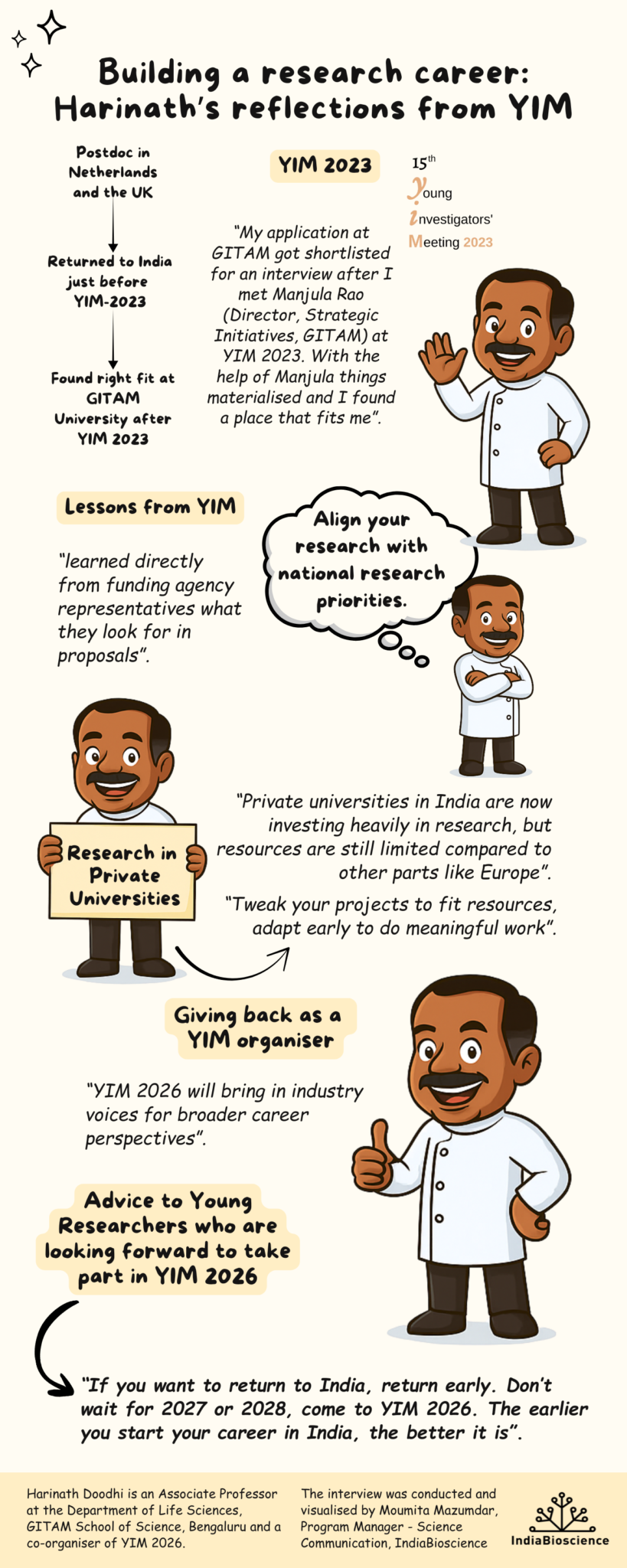
A significant number of encounters at YIMs have evolved beyond conversations to form lasting connections. When Harinath Doodhi attended his first Young Investigators’ Meeting in 2023, after a postdoctoral fellowship in the UK and Netherlands and as a young faculty member at Chennai’s SRM University, he didn’t know this would be a turning point in his career. He met several institutional leaders, one of them being Manjula Rao from GITAM University, an organisation to which Harinath had applied but hadn’t heard back from. One has to be at YIM to know what happened next can only occur at a meeting like this:
“I had applied to GITAM but never heard back. At YIM, Manjula dug up my application, pushed for an interview, and things materialised. I found a place that suited me better than SRM”, he says.
Understanding the funding ecosystem
For Harinath, YIM was not only a way to connect with people, but it was also a crash course in the research funding ecosystem in India. Building relationships and meeting funders helped clarify some ways he could improve the quality of his grant applications.
“I learned directly from funding agency representatives what they look for in proposals. That helped me make small but important changes in my applications. My first grant in India got funded soon after YIM”, he shares.
These early lessons were critical, as he faced numerous challenges in establishing a research lab upon his return to India. They reaffirmed an important point: much of funding success, especially when considering grants, is about being aligned with national priorities.
As Vijay [K VijayRaghavan, a YIM mentor] said, you might have done great work abroad, but every country has its own focus. Aligning with that helps a lot”, Harinath reflects.
Research in private universities: Opportunities and challenges
Harinath has found a home at GITAM University, where he is currently building his group. He acknowledges the emerging role of private institutions in research in India. His experience illustrates the development of a research culture in private universities, which may not have previously been an option for young investigators but is available now.
“Private universities in India are now investing heavily in research, but resources are still limited compared to other parts like Europe. You need to tweak your projects to fit available facilities. If you adapt early, you can still do meaningful research”, he notes.
Giving back as a YIM organiser
Harinath is a co-organiser of YIM 2026 and still regards the meeting as a unique space, providing mentorship, collaboration, and inspiration.
“Mentors and funding bodies give you insights you can’t get elsewhere. This time, including industry voices will also help, since many scientists are curious about careers beyond academia”, he says.
As YIM continues to evolve, Harinath sees another level of change in understanding the implications of expanding its scope to bring together academia, industry, and policy, which is necessary to support the next generation of scientists.
Looking back, Harinath (with a broad smile) offers candid advice to those contemplating a return to India after training from abroad:
If you want to return to India, return early. Don’t wait for 2027 or 2028, come to YIM 2026. The earlier you start your career in India, the better it is”.