Varun Asediya is a researcher interested in how science shapes our lives in ways which we are unaware of as it begins to happen. His work engages in developing interdisciplinary approaches to the evolving interface between biology and technology seamlessly shifting from the mechanisms associated with biological systems to the circuits of our neurons — at the nexus of innovation and imagination where truly transformative possibilities emerge.
His motivation behind writing this op-ed was not simply in reference to buzzwords like ‘CRISPR’ or ‘Artificial Intelligence’ but in regard to ‘timing’ — what we have at present are the scientific advances, skilled manpower, and funding; but what is required now is alignment and accountability — ensuring that our systems, institutions and intentions are aligned simultaneously to take discovery and move it to change.
CRISPR rewrites genes. AI deciphers life’s patterns. Synthetic biology builds living circuits. Together, they signal a shift as momentous as the discovery of DNA.
In May 2025, a newborn in Philadelphia became the first human treated with a CRISPR drug designed uniquely for him. Diagnosed with carbamoyl-phosphate synthetase 1 (CPS1) deficiency, a rare genetic disorder with no neonatal cure. He received a gene-editing therapy built from scratch. It worked.
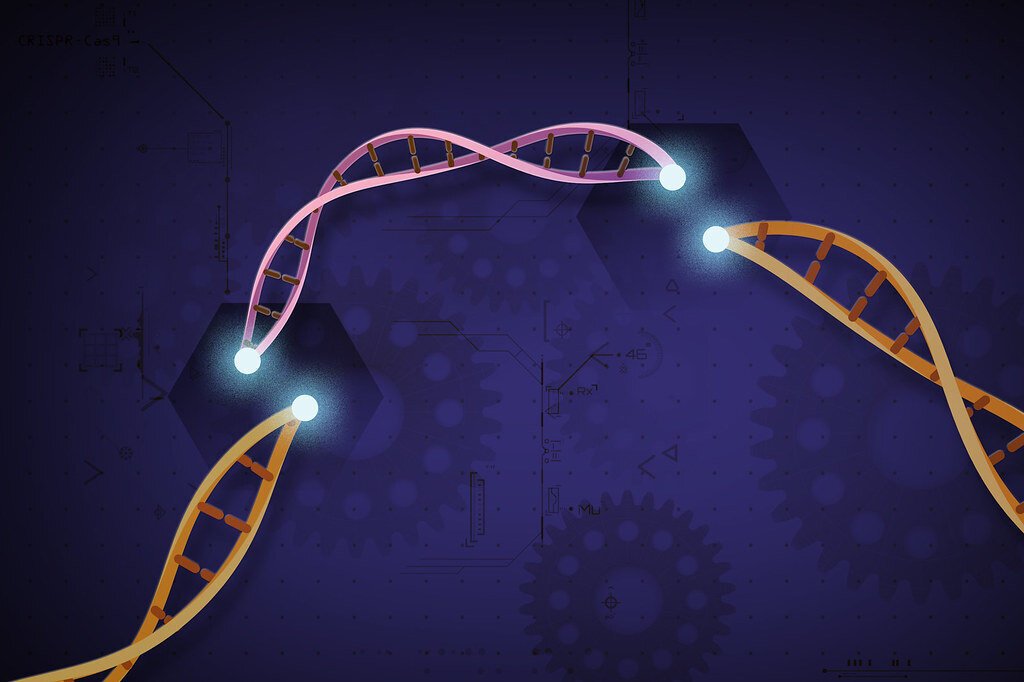
What began as a bacterial alarm system is now the world’s most precise genetic editing tool. CRISPR (Clustered Regularly Interspaced Short Palindromic Repeats) uses a simple trick of nature. A short guide RNA leads the CRISPR-Cas enzyme to a specific stretch of DNA. Cas9 makes the cut. As the cell rushes to repair the break, scientists rewrite the script — deleting mutations, patching faulty genes, or inserting entirely new code. Think of it as a “find and replace” function for life itself.
Early CRISPR tools were bold but blunt. The cuts worked, but they often left the cell under stress. The next wave brought finesse. Base editors swap a single DNA letter without breaking both strands. Prime editors act like a molecular word processor, slipping in or removing precise sequences without collateral damage.
Even the trial-and-error phase is shrinking. AI tools like DeepSpCas9 and EvoDesign now predict where edits will work best, cutting weeks off experiments. What was once a bold idea is now entering the clinic. Prime editing is being tested to treat sickle cell anaemia, progeria, and inherited blindness—proof that CRISPR has crossed from possibility to practice.
Editing DNA is only the beginning. Every change rewrites the cell’s instructions but the real impact depends on the proteins which produce those instructions. Understanding how edited genes shape protein structures and behaviour became the next critical challenge. And that’s where the next breakthrough came — not in DNA, but in proteins.
AlphaFold, ESMFold, and protein prediction
Proteins are long chains of amino acids, usually hundreds of them. These chains must fold into three-dimensional shapes in order to function. But it’s hard to predict how a particular sequence will fold very hard. Old methods such as X‑ray crystallography, NMR spectroscopy, and cryo-electron microscopy are slow and expensive, and plagued by issues such as the challenge of crystallizing certain proteins. Predicting a protein’s shape once took years — and often failed. AI changed that.
In 2020, DeepMind’s AlphaFold2 solved protein structure prediction. What once took years now took hours. By 2024, AlphaFold3 advanced to modelling complexes of proteins, DNA, RNA, and ligands, showing how molecules drive disease, gene regulation, and drug binding. What began as “protein selfies” became full molecular portraits. Meta’s ESMFold added speed, using language models to accelerate predictions.
Why should we care? Because structural learning leads to targeted drug development, rational (e.g., during the COVID-19 pandemic), and even the design of synthetic enzymes to combat industrial pollution.
Synthetic Biology
But biology isn’t just about editing or predicting what already exists. The next step is designing entirely new functions — building life with intent. Synthetic biology isn’t just about inserting new genes; it’s about programming behaviours. One example is the toehold switch, an RNA-based sensor that activates gene expression only in the presence of a specific molecular trigger. These have enabled low-cost diagnostics for Ebola, Zika, and COVID-19.
At the frontier are SynNotch receptors: customisable proteins that let T‑cells recognise complex combinations of cancer markers before attacking. This approach could reduce devastating side effects in immunotherapy.
Molecular recording with SCRIBE and CAMERA
Imagine cells that don’t just react to their environment but remember it — recording chemical exposures over time.
Systems like SCRIBE use CRISPR to write tiny mutations as memory marks. Biological tape recorders extend this concept further, storing complex biochemical memories inside DNA barcodes.
When paired with AI decryption tools, these biological records allow scientists to reconstruct a cell’s life history: when it was stressed, what signals it received, how it evolved.
OrganEx: Resurrecting tissues after death
In 2022, a team at Yale stunned the world by partially reviving pig organs an hour after its death using a system called OrganEx. After one hour of warm ischaemia, OrganEx application preserved tissue integrity, decreased cell death, and restored selected molecular and cellular processes across multiple vital organs. AI algorithms continuously adjusted perfusion pressures, minimising cellular damage during revival. Though full resuscitation remains a distant goal, OrganEx suggests that biological death might be more reversible and more complex than we believed. Applications in transplantation and trauma care are already within sight.
Engineering living medicines
Our microbiome home to trillions of microbes — could become our next pharmacy. Eligo Bioscience engineers bacteriophages to deliver CRISPR payloads, selectively killing harmful bacteria while leaving helpful ones untouched.
Meanwhile, BlueRock Therapeutics creates Induced pluripotent stem cell (iPSC)-derived dopaminergic (DA) neurons to replace those lost in Parkinson’s disease, with AI protocols ensuring cellular precision.
The BioE3 promise and a reality check
BioE3, announced in May 2025, sets aggressive targets for synthetic biology and biomanufacturing. Earlier frameworks — the National Biotechnology Development Strategy (2021−25) and the Digital Personal Data Protection Act (2023) — recognise the need to protect sensitive data, yet no sector-specific regulations now in force tell labs exactly how to encrypt genomic files, log access, or report breaches.
Europe’s GDPR and the U.S. HIPAA illustrate what strong enforcement looks like: Meta was fined €1.2bn in 2023, and Anthem paid US $48.2 million in 2018. India’s record is thinner — a ₹5 crore RBI penalty was imposed on Airtel Payments Bank for Aadhaar-KYC lapses in 2018 and the UIDAI filed complaints against Axis Bank, Suvidhaa Infoserve and eMudhra for unauthorised Aadhaar authentications in 2017. Most safeguards here remain voluntary. Until detailed technical standards, audit trails and real penalties are enacted, BioE3’s bold vision will rest on best practice rather than binding law.
India’s ongoing biosecurity disaster
India can now drop a single point mutation with CRISPR or predict a protein fold in seconds, yet the same laptops let vital records walk out the back door. In one breach after another, hackers cracked CoWIN and Star Health databases, froze All India Institute Of Medical Sciences (AIIMS) with ransomware, and hauled off defence and telecom archives. Even raw biometric scans sat on open servers waiting to be copied.
The message is blunt: our code moves at 21st century speed; our firewalls stay in the last decade. If leaks keep outpacing fixes, trust in gene therapies, AI diagnostics, and engineered microbes will erode before the science matures. Locking data must now rank beside editing DNA as a national research priority.
India’s biotech races; its safeguards hobble. Five proven upgrades might close the gap:
One bioethics council. Replace scattered committees with a statutory body (UK Nuffield style) for open hearings and binding rulings.
A Bio-AI & SynBio act. Audit algorithms, license engineered organisms, enforce genetic containment mirroring FDA software rules and Singapore’s biosafety code.
Instant consent control. Launch a dynamic-consent app like Genomics England’s, so donors can grant or revoke genomic access on demand.
Citizen juries, not token outreach. Fund state-level lay panels; Denmark and Japan prove early public verdicts defuse later backlash.
Mission-mode R&D. Fold CRISPR rice, low-methane herds, and district mRNA clinics into one BioMission—Horizon Europe and DARPA, BioMADE show the template.
India already has the talent and the tools. What remains is the resolve. Secure the guardrails now — and every CRISPR advance might leave our labs bearing a stamp of credibility and not an asterisk of caution.