<?xml version="1.0" encoding="UTF-8"?><feed xmlns="http://www.w3.org/2005/Atom" xml:lang="en"><title>IndiaBioscience - Events</title><link
    rel="alternate"
    href="https://indiabioscience.org/events"
    type="text/html"
    /><link
    rel="self"
    href="https://indiabioscience.org/events/feed"
    type="application/atom+xml"
    /><id>https://indiabioscience.org/events/feed</id><updated>2026-01-08T12:25:21+05:30</updated><entry><title>TNQ Distinguished Lectures in the Life Sciences</title><link
                  rel="alternate"
                  href="https://indiabioscience.org/events/tnq-distinguished-lectures-in-the-life-sciences"
                  type="text/html"
                  /><summary type="html"><![CDATA[
                
<em>
  Other
</em>
from
<time>
  09 February
</time>
  to
  <time>
    13 February 2026
  </time>
at
New Delhi, Mumbai, Bengaluru.
              ]]></summary><id>tag:indiabioscience.org,2026-01-07:/events/tnq-distinguished-lectures-in-the-life-sciences</id><published>2026-01-07T14:27:00+05:30</published><updated>2026-01-07T14:59:14+05:30</updated><content type="html"><![CDATA[
                
<dl><dt>
    Date
  </dt><dd><time datetime="2026-02-09">
      February 09</time><time datetime="2026-02-13">-13, 2026
      </time></dd><dt>
      Locations
    </dt><dd>
      New Delhi, Delhi &amp; NCR
    </dd><dd>
      Mumbai, Maharashtra
    </dd><dd>
      Bengaluru, Karnataka
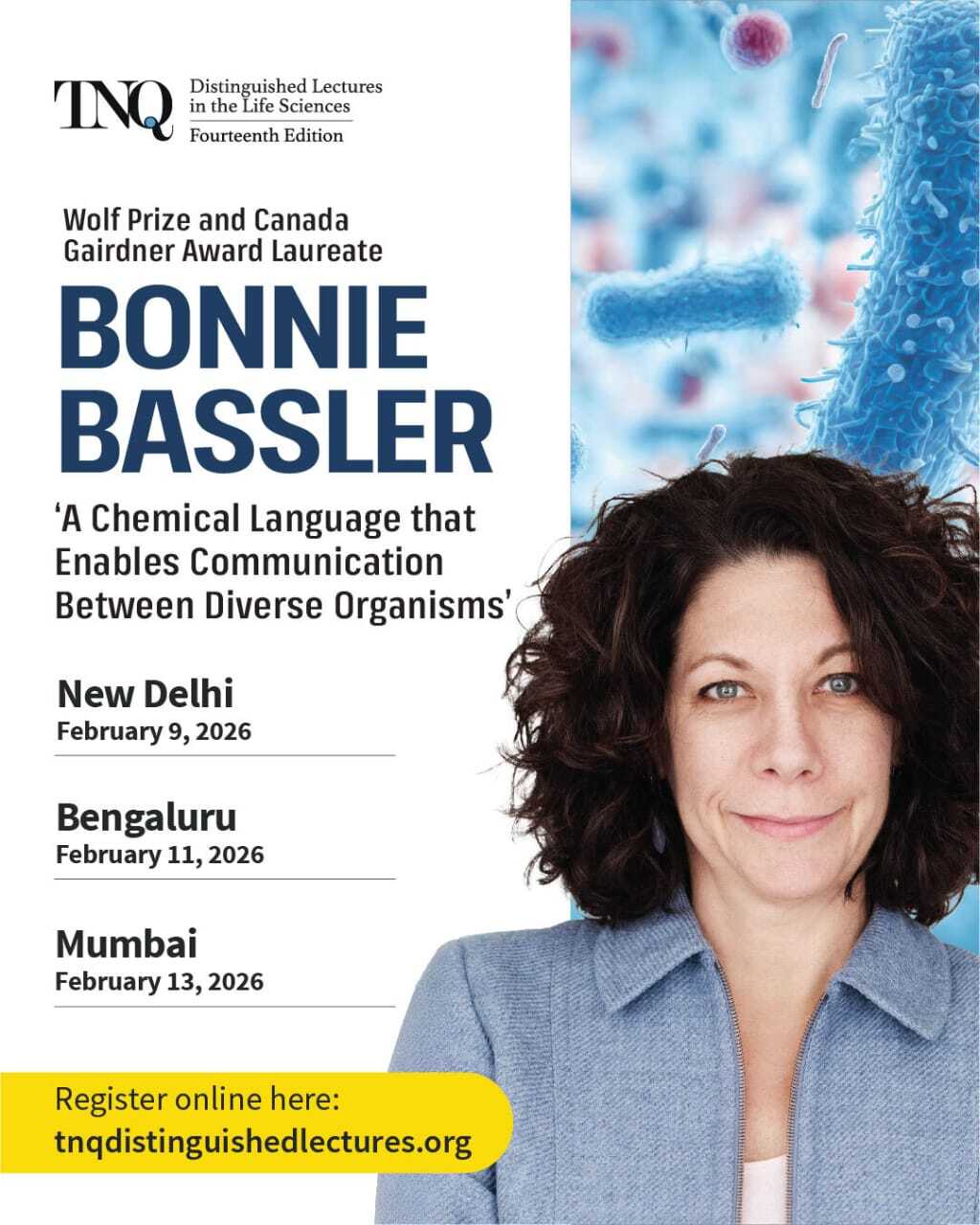
    </dd></dl><p>Fourteenth Edition Speaker: Wolf Prize and the Canada Gairdner Award Laurate, Bonnie Bassler</p><p>The Fourteenth Edition of the TNQ Distinguished Lectures in the Life Sciences are to be delivered by the renowned molecular biologist and professor at Princeton University, Bonnie Bassler, between February 9 and 13 in New Delhi, Bengaluru and Mumbai. <br /><br />Lecture title: A Chemical Language that Enables Communication between Diverse Organisms.<br /></p><p>Professor Bonnie Bassler is best known for her groundbreaking work in the field of bacterial communication, or quorum sensing. Her research has transformed our understanding of how bacteria interact with each other and coordinate behavior—a discovery that has significant implications for medicine, environmental science, and biotechnology. She is the recipient of both the Wolf Prize and the Canada Gairdner Award for her work.<br><br>The Lectures are open to all who register. The schedule is as follows:<br><br>• New Delhi: Monday, February 9, 2026<br>• Bengaluru: Wednesday, February 11, 2026<br>• Mumbai: Friday, February 13, 2026<br><br>Registration link: <a href="https://www.tnqdistinguishedlectures.org/" rel="noopener" target="_blank">https://www.tnqdistinguishedle..</a></p><figure><img src="https://cdn.indiabioscience.org/media/yim/TNQ-Distinguished-Lectures-combined-poster-Rohini-Karandikar.jpeg" data-image="830581"></figure>
              ]]></content><category term="other" label="Other" /><category term="microbiology" label="Microbiology" /><category term="delhi" label="New Delhi" /><category term="mumbai" label="Mumbai" /><category term="bengaluru" label="Bengaluru" /></entry><entry><title>Zebrafish Embryo toxicity, Neurobehavior and Modern Molecular Techniques Protocols</title><link
                  rel="alternate"
                  href="https://indiabioscience.org/events/zebrafish-embryo-toxicity-neurobehavior-and-modern-molecular-techniques-protocols"
                  type="text/html"
                  /><summary type="html"><![CDATA[
                
<em>
  Workshop
</em>
from
<time>
  22 January
</time>
  to
  <time>
    23 January 2026
  </time>
at
Online.
              ]]></summary><id>tag:indiabioscience.org,2026-01-05:/events/zebrafish-embryo-toxicity-neurobehavior-and-modern-molecular-techniques-protocols</id><published>2026-01-05T13:56:00+05:30</published><updated>2026-01-05T13:56:10+05:30</updated><content type="html"><![CDATA[
                
<dl><dt>
    Date
  </dt><dd><time datetime="2026-01-22">
      January 22</time><time datetime="2026-01-23">-23, 2026
      </time></dd><dt>
      Location
    </dt><dd>
      Online
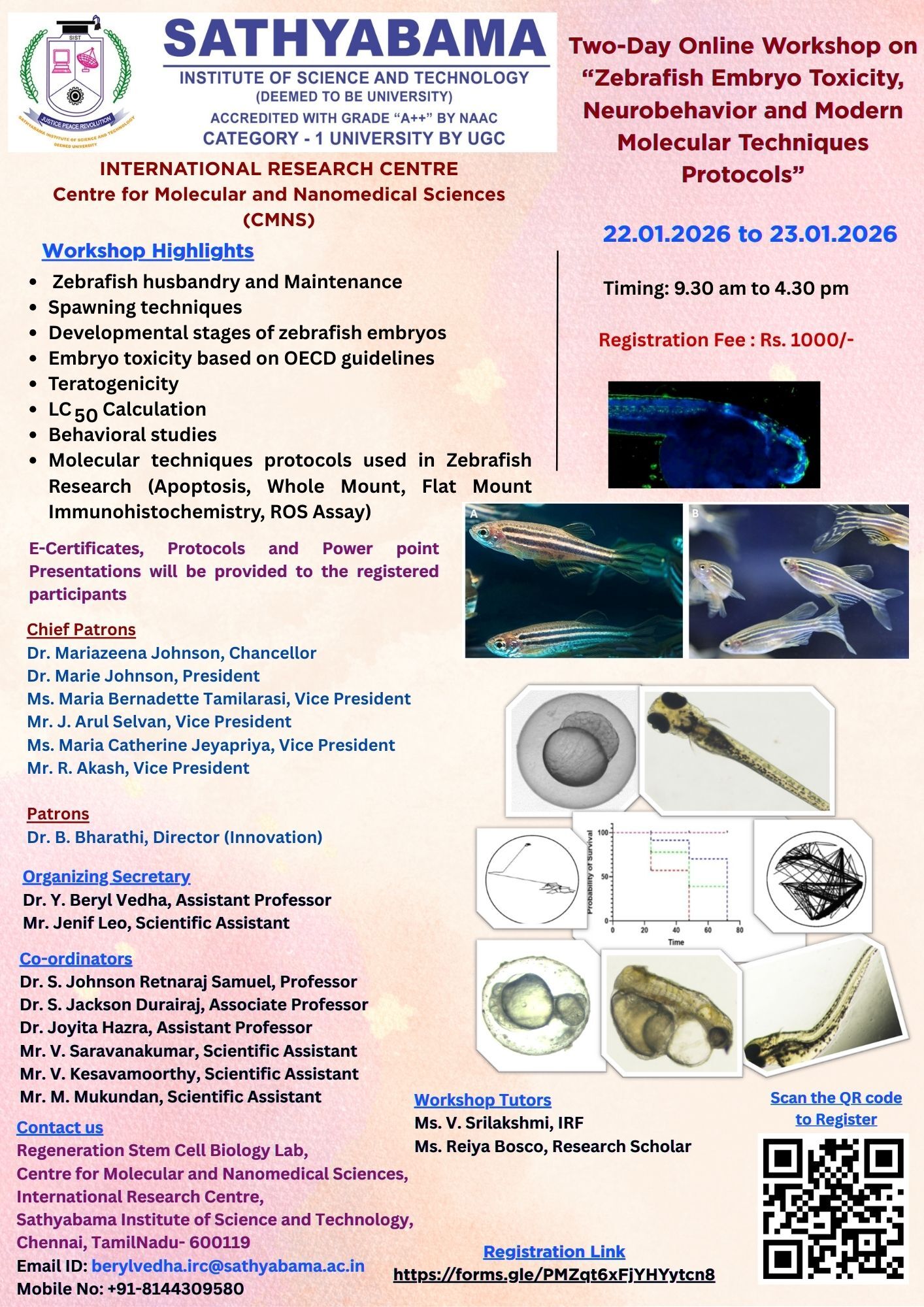
    </dd></dl><p>Sathyabama Institute of Science and Technology is organizing a Two-day online workshop on " Zebrafish Embryo toxicity, Neurobehavior and Modern Molecular Techniques Protocols" on 22nd to 23rd January 2026 at 9.30 am to 4.00pm.</p><p>Zebrafish (Danio rerio) has become a prominent vertebrate model for understanding the pathophysiology of the disease, in vivo model for development, neurotoxicity research and many more. This workshop is intended for Students (UG &amp; PG)/ Research Scholars/ Academic Professionals/ Industrialists to understand the use of zebrafish models in scientific research. The workshop includes introductory lectures on zebrafish models related to zebrafish husbandry, developmental stages, embryotoxicity.</p><figure><img src="https://cdn.indiabioscience.org/media/yim/Zebrafish-Online-Workshop-Jan-2026.jpg" data-image="823252"></figure>
              ]]></content><category term="workshop" label="Workshop" /><category term="online" label="Online" /></entry><entry><title>Molecular Docking, Biological Software Packages and Cell Culture Techniques Protocol</title><link
                  rel="alternate"
                  href="https://indiabioscience.org/events/hands-on-online-workshop-molecular-docking-biological-software-packages-and-cell-culture-techniques-protocol"
                  type="text/html"
                  /><summary type="html"><![CDATA[
                
<em>
  Workshop
</em>
from
<time>
  29 January
</time>
  to
  <time>
    31 January 2026
  </time>
at
Online.
              ]]></summary><id>tag:indiabioscience.org,2026-01-05:/events/hands-on-online-workshop-molecular-docking-biological-software-packages-and-cell-culture-techniques-protocol</id><published>2026-01-05T13:50:00+05:30</published><updated>2026-01-06T11:07:13+05:30</updated><content type="html"><![CDATA[
                
<dl><dt>
    Date
  </dt><dd><time datetime="2026-01-29">
      January 29</time><time datetime="2026-01-31">-31, 2026
      </time></dd><dt>
      Location
    </dt><dd>
      Online
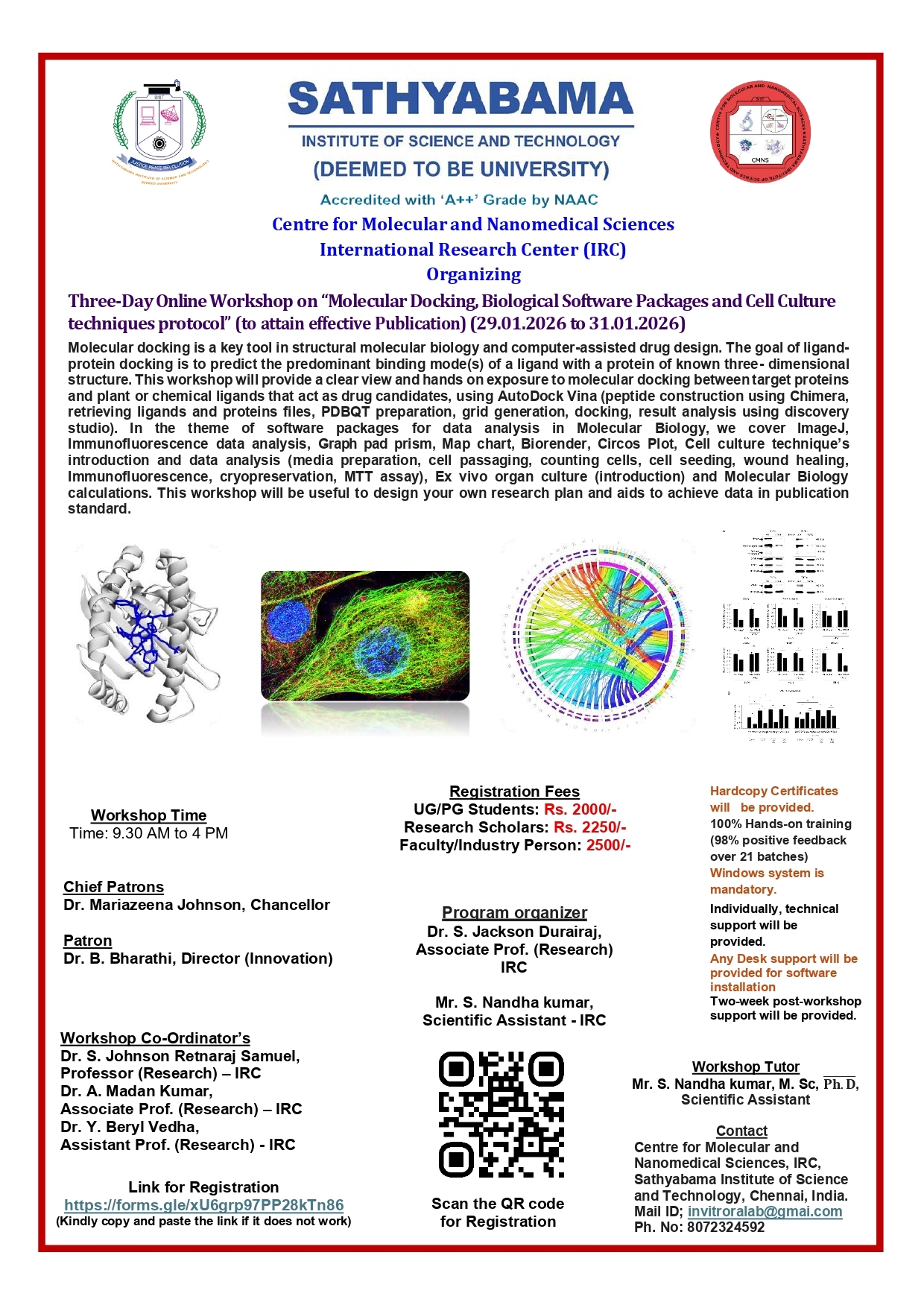
    </dd></dl><p>Sathyabama Institute of Science and Technology invite for the Hands-on Online Workshop (Zoom Platform) on​“Molecular Docking, Biological Software Packages and Cell Culture Techniques” (to attain publication) between 29th – 31st January, 2026’; Timing 09.30 am to 4.00 pm (IST), Organised by the Centre for Molecular and Nanomedical Sciences, International Research Centre (IRC), Sathyabama Institute of Science and Technology, Chennai. This workshop will provide a platform for the beginners to explore molecular docking, computational and cell culture techniques and implement these techniques in their field of research. Kindly find the attached brochure for complete details.</p><p>Following computational techniques such as; Molecular Docking using AutoDock Vina (Protein-ligand); Ligand preparation — Chimera; Docking analysis; Protein and Ligand preparation; Grid generation; Result analysis using Discovery Studio; Protein target screening and toxicity prediction will be covered. This workshop will provide a platform for the beginners to explore molecular docking, computational and cell culture techniques and implement these techniques in their field of research.<br><br>In the theme of data analysis, we are going to teach<br></p><ol><li>ImageJ — Java-based image processing program, we can use it for many biological research experiments example western blotting, wound healing, immunofluorescence etc.,</li><li>Biorender — Scientific diagrams, and illustrations.<br></li><li>Circos Plot — Circos ideal for exploring relationships between objects or positions.</li><li>Mapchart — Make your own custom map of the World.</li><li>GraphPad Prism — Data analysis and graphing software (Survival graph).</li></ol><p>Cell culture techniques and protocols include media preparation, cell passaging, counting cells in a Haemocytometer, cell seeding for MTT, wound healing and Immunofluorescence, cryopreservation, MTT assay and ex vivo organ (intro) calculations. Molecular Biology calculation includes stock and working concentration preparation and other basics.</p><figure><img src="https://cdn.indiabioscience.org/media/yim/Brochure-2.jpg" data-image="823271"></figure>
              ]]></content><category term="workshop" label="Workshop" /><category term="molecular-biology" label="Molecular Biology" /><category term="online" label="Online" /></entry><entry><title>Animal Cell Culture Techniques</title><link
                  rel="alternate"
                  href="https://indiabioscience.org/events/animal-cell-culture-techniques"
                  type="text/html"
                  /><summary type="html"><![CDATA[
                
<em>
  Workshop
</em>
from
<time>
  05 February
</time>
  to
  <time>
    07 February 2026
  </time>
at
Chennai.
              ]]></summary><id>tag:indiabioscience.org,2026-01-05:/events/animal-cell-culture-techniques</id><published>2026-01-05T11:51:00+05:30</published><updated>2026-01-05T11:51:09+05:30</updated><content type="html"><![CDATA[
                
<dl><dt>
    Date
  </dt><dd><time datetime="2026-02-05">
      February 05</time><time datetime="2026-02-07">-07, 2026
      </time></dd><dt>
      Location
    </dt><dd>
      Chennai, Tamil Nadu
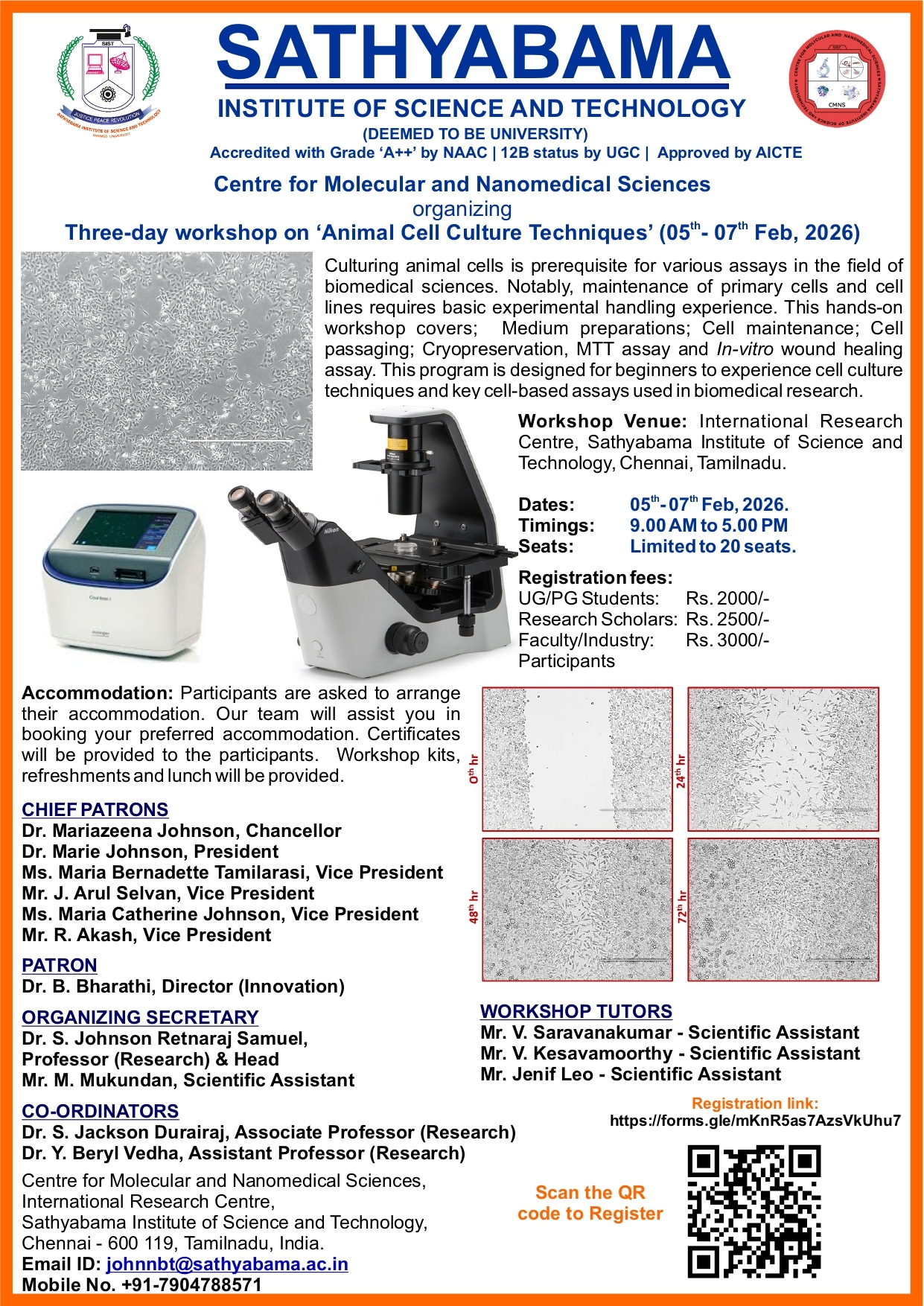
    </dd></dl><p>Sathyabama Institute of Science and Technology is organising a Three-day workshop on ‘Animal Cell Culture Techniques’ (05th - 07th Feb, 2026) at the 'International Research Center of Sathyabama Institute of Science and Technology, Chennai through physical mode.<br /><br />Culturing animal cells is a prerequisite for various assays in the field of biomedical sciences. Notably, maintenance of primary cells and cell lines requires basic experimental handling experience.</p><p> This hands-on workshop covers;<br />Medium preparations<br />Cell maintenance<br />Cell passaging<br />Cryopreservation<br />MTT assay<br /><em>In-vitro</em> wound healing assay</p><figure><img src="https://cdn.indiabioscience.org/media/yim/Sathyabama_Animal-cell-culture-workshop_Brochure_2026__page-0001.jpg" data-image="823241"></figure>
              ]]></content><category term="workshop" label="Workshop" /><category term="chennai" label="Chennai" /></entry><entry><title>Cancer in young adults: from correlation to causation</title><link
                  rel="alternate"
                  href="https://indiabioscience.org/events/cancer-in-young-adults-from-correlation-to-causation"
                  type="text/html"
                  /><summary type="html"><![CDATA[
                
<em>
  Workshop
</em>
from
<time>
  04 February
</time>
  to
  <time>
    07 February 2026
  </time>
at
Chennai.
              ]]></summary><id>tag:indiabioscience.org,2026-01-02:/events/cancer-in-young-adults-from-correlation-to-causation</id><published>2026-01-02T13:14:00+05:30</published><updated>2026-01-05T15:59:53+05:30</updated><content type="html"><![CDATA[
                
<dl><dt>
    Date
  </dt><dd><time datetime="2026-02-04">
      February 04</time><time datetime="2026-02-07">-07, 2026
      </time></dd><dt>
      Location
    </dt><dd>
      Chennai, Tamil Nadu
    </dd><dt>Website</dt><dd><a
        href="https://meetings.embo.org/event/26-cancer">
        meetings.embo.org/event/26-can… &rarr;
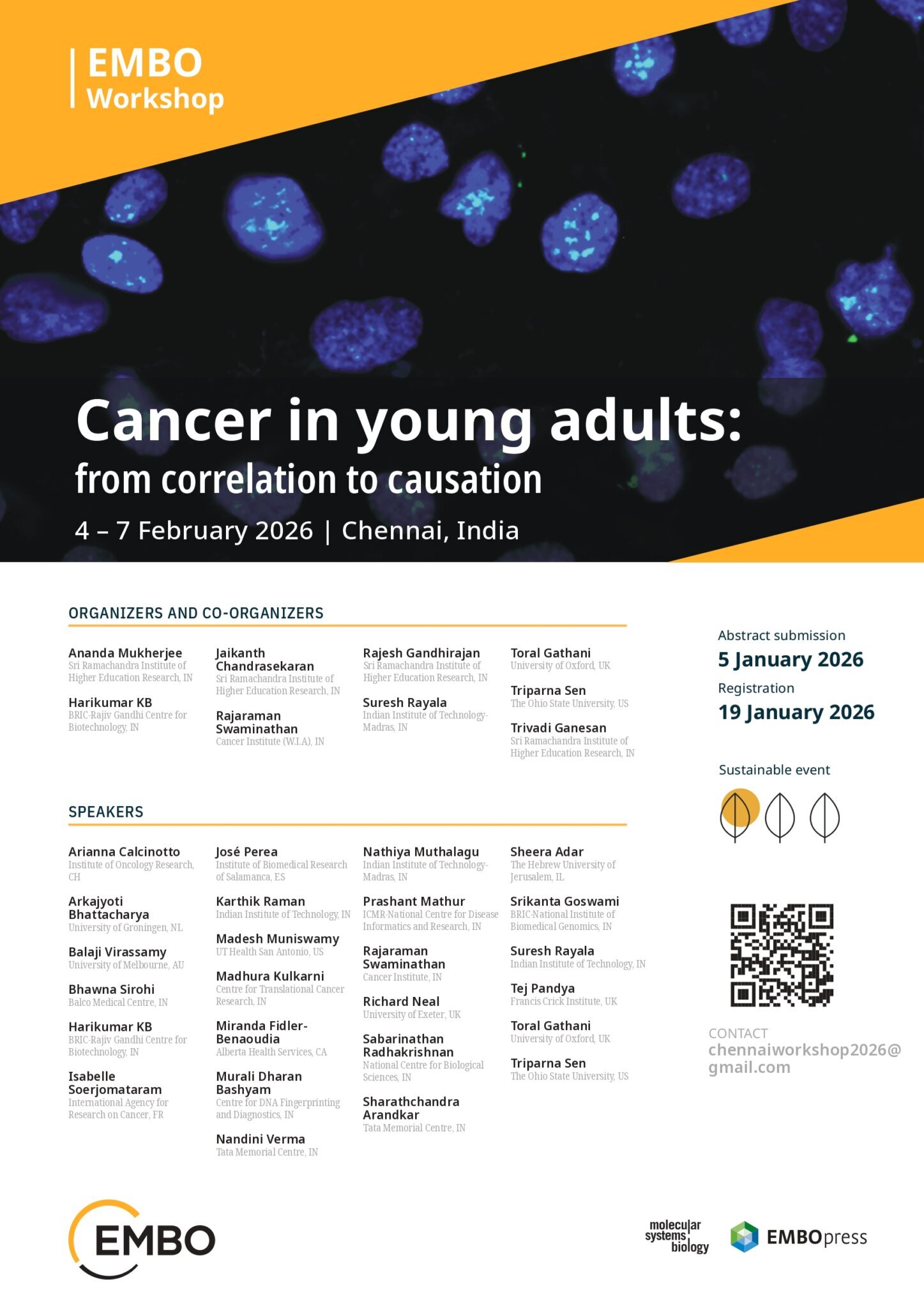
      </a></dd></dl><p>In the past thirty years, the incidence of the most prevalent cancer types has risen by approximately 80% among young adults who are under 50 years old globally. This situation is especially troubling for India, considering that more than half of its population are under 50 years. The reason for this increase in incidence is unclear due to insufficient understanding of etiology and mechanisms. Recent advances in multidimensional data analysis, encompassing clinical observations and omics-based exposome studies, are facilitating a preliminary understanding of the underlying causes of cancer in young adults. This EMBO Workshop will address epidemiology, emerging risk factors and strategies, gene-environment interactions, etiology and molecular pathologies, biological foundations and molecular mechanisms, preclinical experimental and simulation models, as well as precision medicine and treatment modalities. This EMBO Workshop will support in addressing challenges by enhancing our knowledge via collaborative efforts.<br /></p><p>EMBO Courses and Workshops are selected for their excellent scientific quality and timelines, provision of good networking activities for all participants and speaker gender diversity (at least 40% of speakers must be from the underrepresented gender).</p><p>Organisers are encouraged to implement measures to make the meeting environmentally more sustainable.</p><figure><img src="https://cdn.indiabioscience.org/media/yim/gw26-15-Poster_page-0001.jpg" data-image="823244"></figure>
              ]]></content><category term="workshop" label="Workshop" /><category term="chennai" label="Chennai" /></entry><entry><title>qPCR and data analysis</title><link
                  rel="alternate"
                  href="https://indiabioscience.org/events/qpcr-and-data-analysis-3"
                  type="text/html"
                  /><summary type="html"><![CDATA[
                
<em>
  Workshop
</em>
from
<time>
  02 February
</time>
  to
  <time>
    04 February 2026
  </time>
at
Chennai.
              ]]></summary><id>tag:indiabioscience.org,2025-12-31:/events/qpcr-and-data-analysis-3</id><published>2025-12-31T15:56:00+05:30</published><updated>2025-12-31T15:56:25+05:30</updated><content type="html"><![CDATA[
                
<dl><dt>
    Date
  </dt><dd><time datetime="2026-02-02">
      February 02</time><time datetime="2026-02-04">-04, 2026
      </time></dd><dt>
      Location
    </dt><dd>
      Chennai, Tamil Nadu
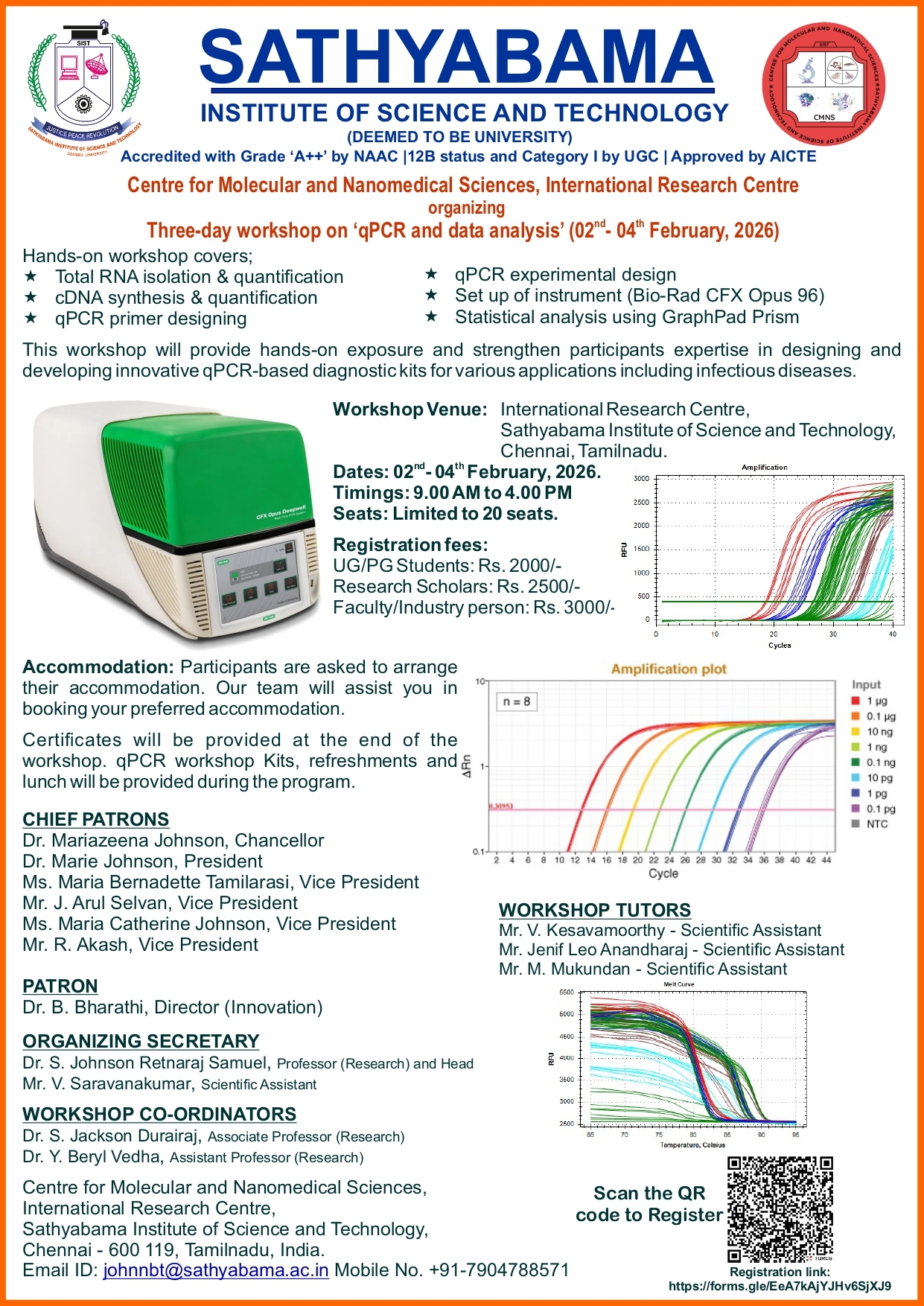
    </dd></dl><p>Sathyabama Institute of Science and Technology is organising a Three-day workshop on ‘qPCR and data analysis’ (02nd- 04th February, 2026) at the 'International Research Center of Sathyabama Institute of Science and Technology, Chennai through physical mode.<br /><br />This workshop will provide hands-on exposure and strengthen participant's expertise in designing and developing innovative qPCR-based diagnostic kits for various applications, including infectious diseases.<br /><br />Hands-on workshop covers;</p><ul><li>cDNA synthesis &amp; quantification</li><li>Total RNA isolation &amp; quantification</li><li>qPCR primer designing</li><li>qPCR experimental design</li><li>Set up of instrument (Bio-Rad CFX Opus 96)</li><li>Statistical analysis using GraphPad Prism</li></ul><figure><img src="https://cdn.indiabioscience.org/media/yim/qPCR_Workshop_Brochure-2026_page-0001.jpg" data-image="823197"></figure>
              ]]></content><category term="workshop" label="Workshop" /><category term="chennai" label="Chennai" /></entry><entry><title>Cancer cell culture techniques</title><link
                  rel="alternate"
                  href="https://indiabioscience.org/events/cancer-cell-culture-techniques-2"
                  type="text/html"
                  /><summary type="html"><![CDATA[
                
<em>
  Workshop
</em>
from
<time>
  06 February
</time>
  to
  <time>
    07 February 2026
  </time>
at
Chennai.
              ]]></summary><id>tag:indiabioscience.org,2025-12-31:/events/cancer-cell-culture-techniques-2</id><published>2025-12-31T11:13:00+05:30</published><updated>2025-12-31T11:13:38+05:30</updated><content type="html"><![CDATA[
                
<dl><dt>
    Date
  </dt><dd><time datetime="2026-02-06">
      February 06</time><time datetime="2026-02-07">-07, 2026
      </time></dd><dt>
      Location
    </dt><dd>
      Chennai, Tamil Nadu
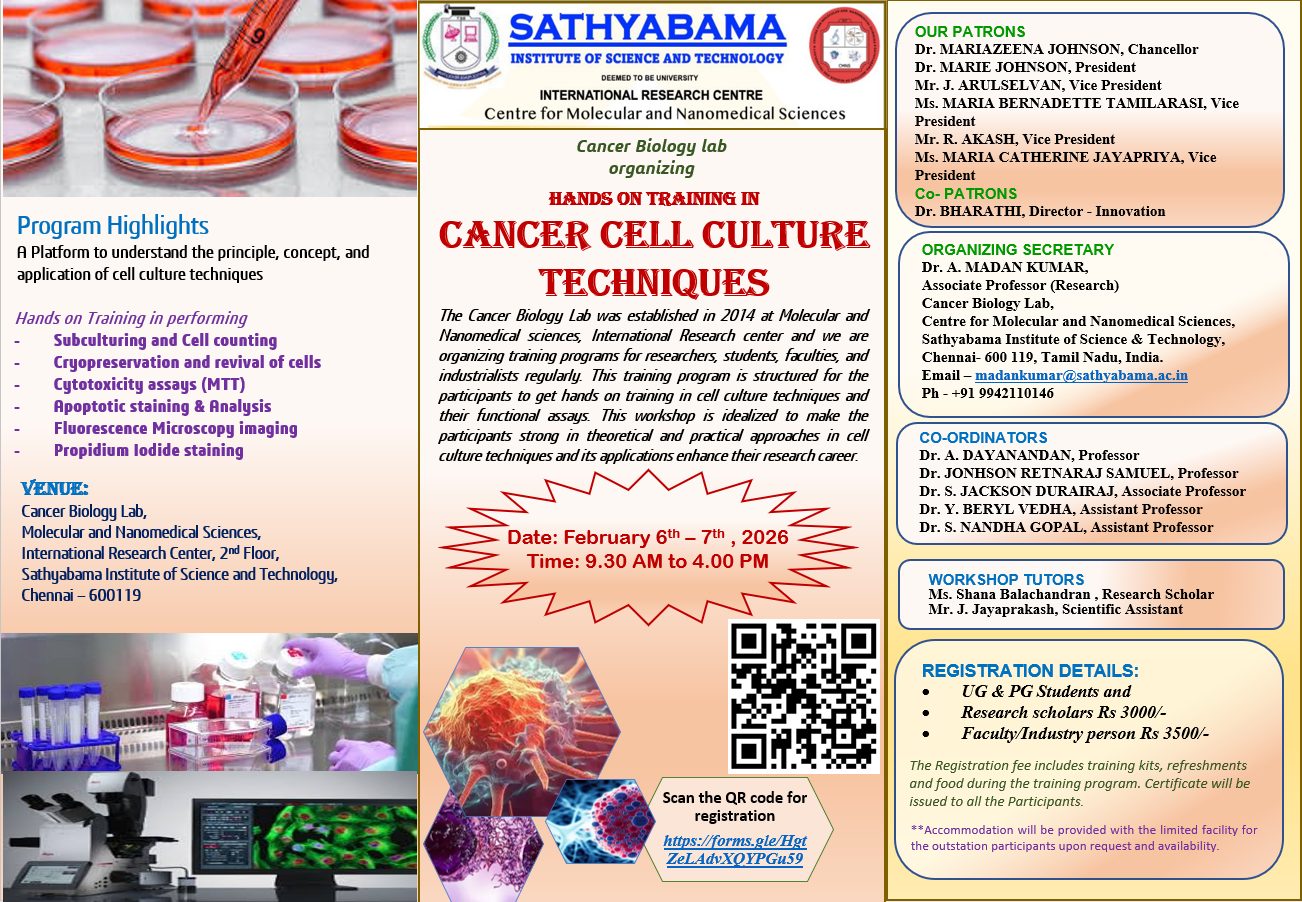
    </dd></dl><p>Sathyabama Institute of Science and Technology is organising Two days workshop in "Cancer cell culture techniques" which will be held on February 6th to 7th, 2026 at our Cancer biology lab, International Research Centre, Sathyabama Institute of Science and Technology, Chennai through Physical mode.</p><p>The program will cover an introduction to in vitro cancer cell maintenance and Hands on Training in performing on Subculturing and Cell counting, Cryopreservation and revival of cells, Cytotoxicity assays (MTT), Apoptotic staining &amp; Analysis, Propidium Iodide staining. Participants will gain insights into in vitro and advanced imaging techniques. The workshop also includes intensive practical training modules and detailed sessions on cancer cell culture for experimental research.</p><p>WHO CAN ATTEND: UG/PG students, Research Scholars, Scientists, Faculties, and industrial people are eligible to apply</p><figure><img src="https://cdn.indiabioscience.org/media/yim/Cancer-cell-culture-training-Feb-2026.png" data-image="823187"></figure>
              ]]></content><category term="workshop" label="Workshop" /><category term="chennai" label="Chennai" /></entry><entry><title>Biomedical Techniques in Modern Biology</title><link
                  rel="alternate"
                  href="https://indiabioscience.org/events/biomedical-techniques-in-modern-biology-4"
                  type="text/html"
                  /><summary type="html"><![CDATA[
                
<em>
  Other
</em>
from
<time>
  09 February
</time>
  to
  <time>
    18 March 2026
  </time>
at
Chennai.
              ]]></summary><id>tag:indiabioscience.org,2025-12-30:/events/biomedical-techniques-in-modern-biology-4</id><published>2025-12-30T16:03:00+05:30</published><updated>2025-12-30T16:03:34+05:30</updated><content type="html"><![CDATA[
                
<dl><dt>
    Date
  </dt><dd><time datetime="2026-02-09">
      February 09</time><time datetime="2026-03-18">-March 18, 2026
      </time></dd><dt>
      Location
    </dt><dd>
      Chennai, Tamil Nadu
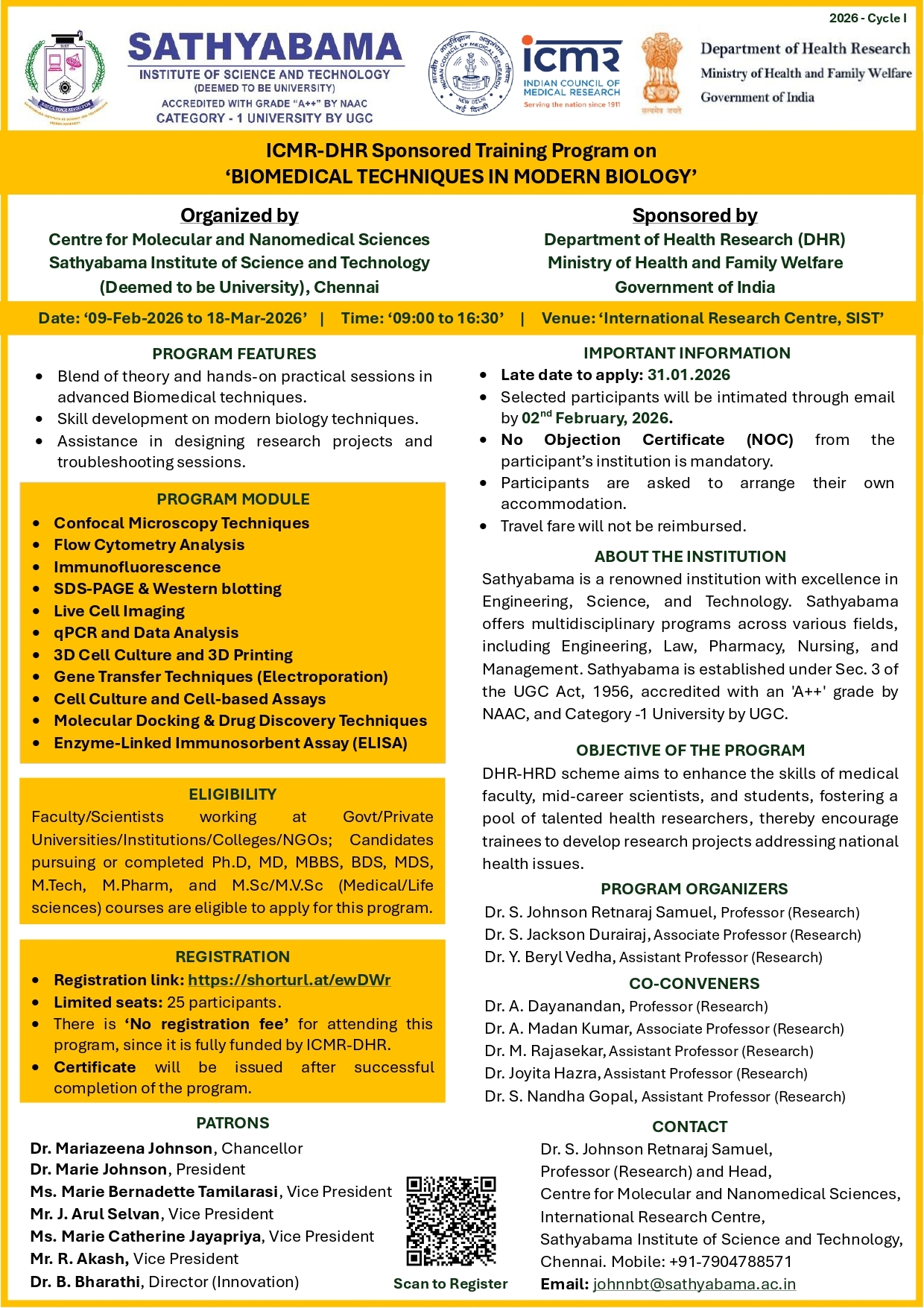
    </dd></dl><p>Sathyabama Institute of Science and Technology, Chennai is organising a Training Program on ‘BIOMEDICAL TECHNIQUES IN MODERN BIOLOGY’ Sponsored by the Department of Health Research (ICMR-DHR) from 09th February to 18th March 2026 at 'International Research Center of Sathyabama Institute of Science and Technology, Chennai through physical mode.<br /><br />This workshop provides hands-on training in biomedical techniques Confocal Microscopy techniques, Flow Cytometry Analysis, Immunofluorescence and Immunoblotting, Live Cell Imaging, qPCR Analysis, 3D Cell Culture and 3D Printing, Gene Transfer Techniques, Cell Culture and Cell-based Assays, Advanced Microscopy Techniques and Molecular Docking.</p><p>WHO CAN ATTEND: Faculty/Scientists working at Govt/Private Universities/Institutions/Colleges/NGO; Candidates pursuing or completed Ph.D, MD, MBBS, BDS, MDS, M.Tech, M.Pharm, and M.Sc (Medical/Life sciences) courses are eligible to apply for this program.</p><figure><img src="https://cdn.indiabioscience.org/media/yim/DHR_brochure_SIST_page-0001.jpg" data-image="823180"></figure>
              ]]></content><category term="other" label="Other" /><category term="chennai" label="Chennai" /></entry><entry><title>SpARC MEETING: Epithelial Mesenchymal Transitions (EMT) in Cancer</title><link
                  rel="alternate"
                  href="https://indiabioscience.org/events/sparc-meeting-epithelial-mesenchymal-transitions-emt-in-cancer"
                  type="text/html"
                  /><summary type="html"><![CDATA[
                
<em>
  Other
</em>
from
<time>
  06 March
</time>
  to
  <time>
    07 March 2026
  </time>
at
Bengaluru.
              ]]></summary><id>tag:indiabioscience.org,2025-12-27:/events/sparc-meeting-epithelial-mesenchymal-transitions-emt-in-cancer</id><published>2025-12-27T08:07:00+05:30</published><updated>2025-12-27T19:19:02+05:30</updated><content type="html"><![CDATA[
                
<dl><dt>
    Date
  </dt><dd><time datetime="2026-03-06">
      March 06</time><time datetime="2026-03-07">-07, 2026
      </time></dd><dt>
      Location
    </dt><dd>
      Bengaluru, Karnataka
    </dd></dl><p>Ignite Life Science Foundation Invites applications for Full-time faculty, PhDs and Post-doctoral fellows to participate in SpARC MEETING: Epithelial Mesenchymal Transitions (EMT) in Cancer- A Special Academic Cooperative (SpARC) Meeting, to generate interdisciplinary ideas leading to innovation in cancer treatment.</p><p>Hosted by Professors Ramray Bhat and Mohit Kumar Jolly (IISc) and Supported by Ignite Life Science Foundation.</p><p>SpARC meetings are small interdisciplinary meetings where a curated group of participants engage in a brainstorming-style event to probe the known-unknowns in a given area, and suggest the scientific approaches that could help solve the unknowns. A small amount of funding will be available for proposals received as an outcome of this meeting. </p><p>For Faculties: </p><p>Ignite is now calling for an Expression of Interest to attend this meeting for full-time faculty, clinicians, and pathologists. If your EoI is accepted, you will receive a formal invite (before January 15, 2026) to attend the meeting. Anyone can apply, although preference will be given to scientists who are actively working on the science related to the topic.</p><p>The key domains covered in the meeting will be experimental biology, computational systems biology, clinical pathology, clinical oncology and developmental biology.</p><p>Click <a href="https://docs.google.com/forms/d/e/1FAIpQLSfKzVm1DeEEmeehxdwqhjeWh7I_Ftzr7akDKv46xHF2sDLG8Q/viewform" target="_blank">here</a> to apply to attend the meeting.<br><br>Last date to apply is 10th January 2026, and we expect to announce the names of selected participants by 15th January 2026. Accommodation will be provided at IISc for outstation participants. <br><br>For PhDs and Post-doctoral Fellows<br>Grab the opportunity to attend the Cancer EMT SpARC Meeting-SpARC Award Challenge</p><p>Doctoral students and postdoctoral researchers are invited to apply for travel support to participate in this meeting.<br><br>Funding support includes reimbursement of:<br>• Economy-class air travel (from anywhere within India)<br>• Accommodation<br>• All meals<br><br>Reimbursements will be made at actuals against original receipts after attendance at the meeting.<br><br>Last Date to apply is 20th Jan 2026<br>Click here to apply: <a href="https://docs.google.com/forms/u/0/d/1RMfqUsjeQ0Oa6PVQvhmKQTmhYxoeTDBuUjU2ISw6ANI/viewform?urp=gmail_link&edit_requested=true" target="_blank">Google Form</a></p>
              ]]></content><category term="other" label="Other" /><category term="bengaluru" label="Bengaluru" /></entry><entry><title>Zebrafish Model: Advances in Preclinical and Toxicological Research</title><link
                  rel="alternate"
                  href="https://indiabioscience.org/events/zebrafish-model-advances-in-preclinical-and-toxicological-research"
                  type="text/html"
                  /><summary type="html"><![CDATA[
                
<em>
  Workshop
</em>
from
<time>
  30 January
</time>
  to
  <time>
    31 January 2026
  </time>
at
Chennai.
              ]]></summary><id>tag:indiabioscience.org,2025-12-22:/events/zebrafish-model-advances-in-preclinical-and-toxicological-research</id><published>2025-12-22T10:10:00+05:30</published><updated>2025-12-22T10:10:00+05:30</updated><content type="html"><![CDATA[
                
<dl><dt>
    Date
  </dt><dd><time datetime="2026-01-30">
      January 30</time><time datetime="2026-01-31">-31, 2026
      </time></dd><dt>
      Location
    </dt><dd>
      Chennai, Tamil Nadu
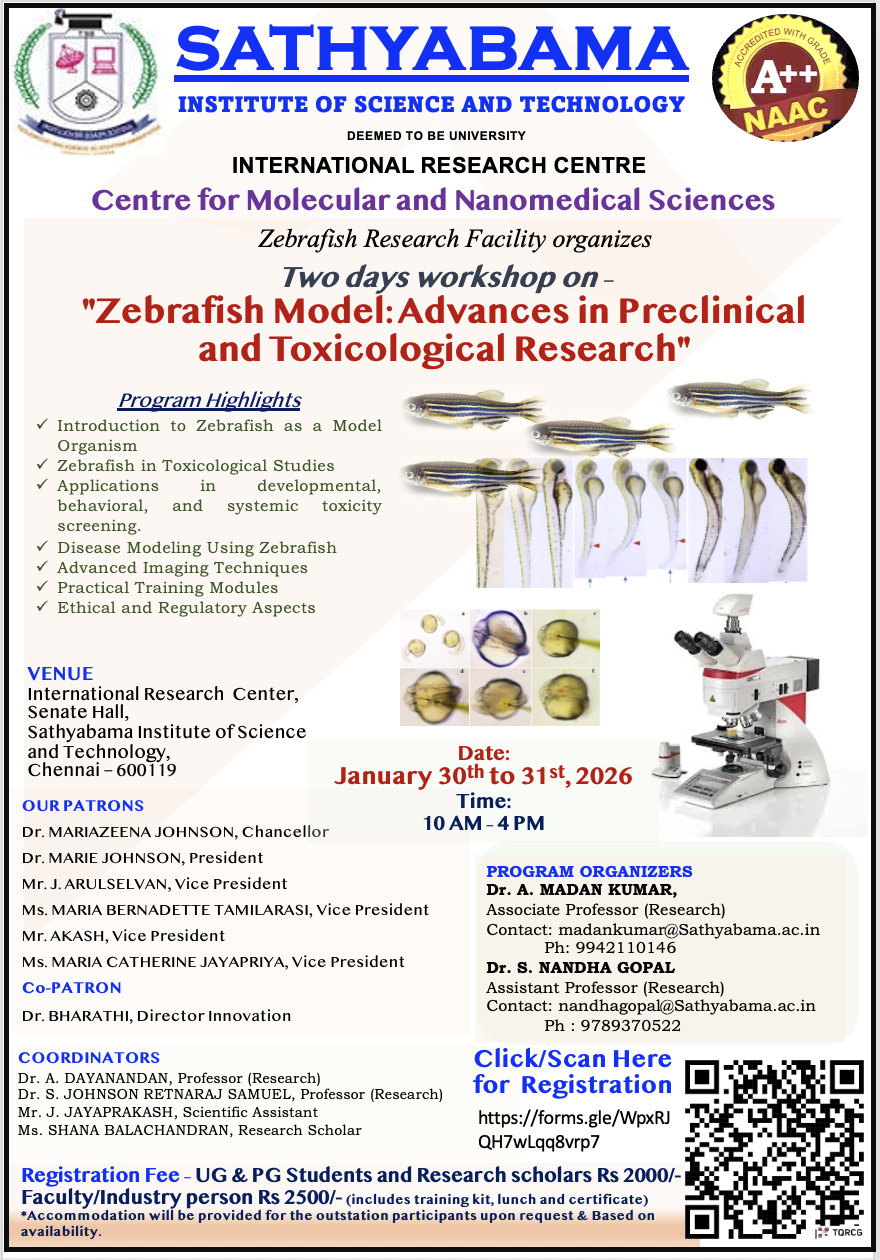
    </dd></dl><p>Sathyabama Institute of Science and Technology is organising Two days workshop in "Zebrafish Model: Advances in Preclinical and Toxicological Research" which will be held on January 30th to 31st, 2026 at our Cancer biology lab, International Research Centre, Sathyabama Institute of Science and Technology, Chennai through Physical mode.</p><p>The program will cover an introduction to zebrafish biology and its significance as a model system, applications in toxicological studies, and its role in developmental, behavioral, and systemic toxicity screening. Participants will gain insights into disease modeling using zebrafish and advanced imaging techniques. The workshop also includes intensive practical training modules and detailed sessions on ethical and regulatory aspects governing zebrafish research. This training program will be highly beneficial for students, researchers, and faculty interested in translational and experimental research.<br /></p><p>WHO CAN ATTEND: UG/PG students, Research Scholars, Scientists, Faculties, and industrial people are eligible to apply.</p><figure><img src="https://cdn.indiabioscience.org/media/yim/Zebrafish-Training-program-Jan-30-31st-2026.png" data-image="823066"></figure>
              ]]></content><category term="workshop" label="Workshop" /><category term="chennai" label="Chennai" /></entry><entry><title>One Week Certified Internship Program on Structural Bioinformatics</title><link
                  rel="alternate"
                  href="https://indiabioscience.org/events/one-week-certified-internship-program-on-structural-bioinformatics"
                  type="text/html"
                  /><summary type="html"><![CDATA[
                
<em>
  Other
</em>
from
<time>
  16 February
</time>
  to
  <time>
    21 February 2026
  </time>
at
Online.
              ]]></summary><id>tag:indiabioscience.org,2025-12-16:/events/one-week-certified-internship-program-on-structural-bioinformatics</id><published>2025-12-16T12:34:00+05:30</published><updated>2025-12-16T12:34:57+05:30</updated><content type="html"><![CDATA[
                
<dl><dt>
    Date
  </dt><dd><time datetime="2026-02-16">
      February 16</time><time datetime="2026-02-21">-21, 2026
      </time></dd><dt>
      Location
    </dt><dd>
      Online
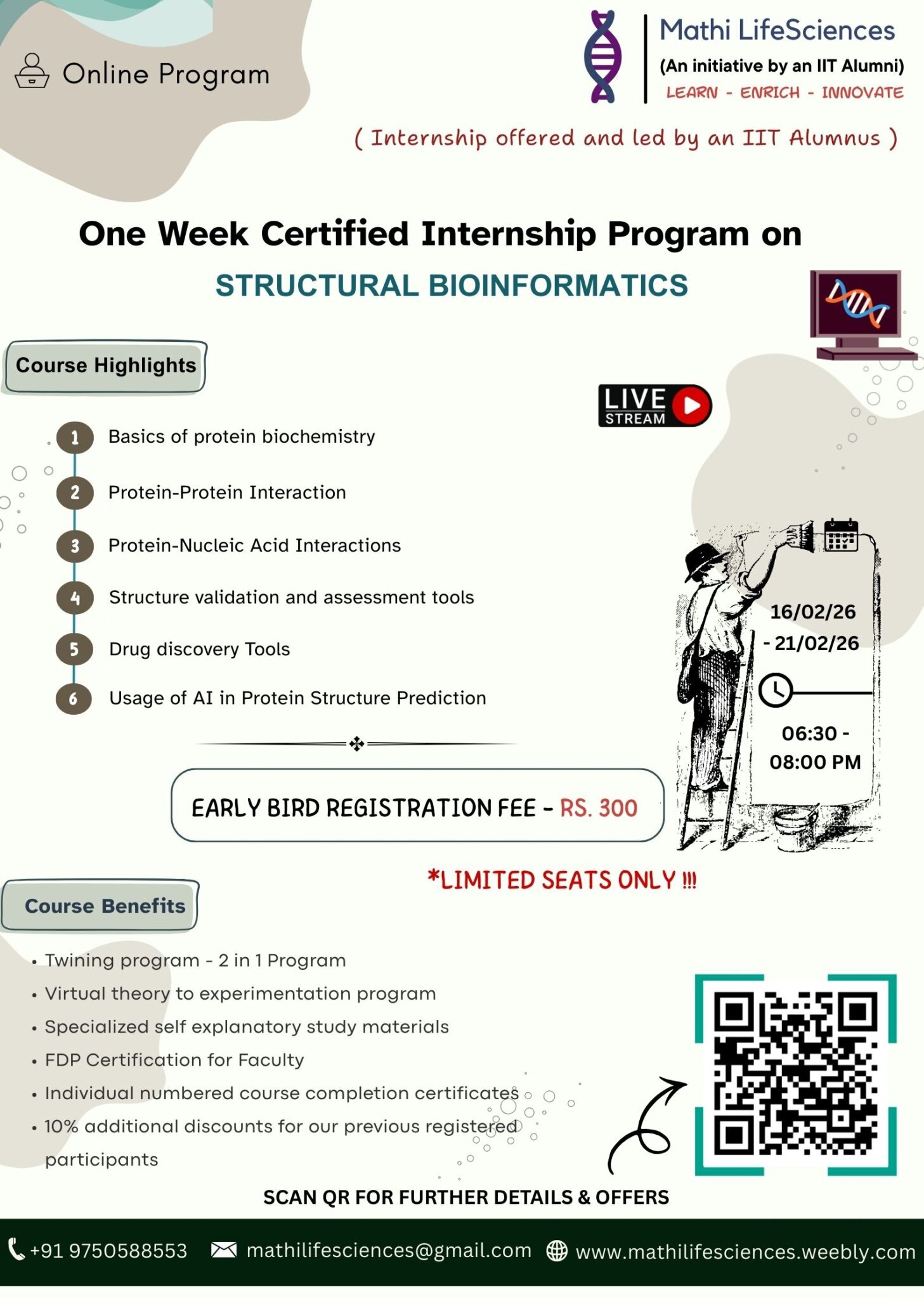
    </dd></dl><figure><img src="https://cdn.indiabioscience.org/media/yim/Structural-Bioinformatics-Feb-26.jpg" data-image="822964"></figure>
              ]]></content><category term="other" label="Other" /><category term="online" label="Online" /></entry><entry><title>One Week Certified Intership Program on Molecular Modelling and Drug Designing</title><link
                  rel="alternate"
                  href="https://indiabioscience.org/events/one-week-certified-intership-program-on-molecular-modelling-and-drug-designing"
                  type="text/html"
                  /><summary type="html"><![CDATA[
                
<em>
  Other
</em>
from
<time>
  20 January
</time>
  to
  <time>
    27 January 2026
  </time>
at
Online.
              ]]></summary><id>tag:indiabioscience.org,2025-12-16:/events/one-week-certified-intership-program-on-molecular-modelling-and-drug-designing</id><published>2025-12-16T12:32:00+05:30</published><updated>2025-12-16T13:54:04+05:30</updated><content type="html"><![CDATA[
                
<dl><dt>
    Date
  </dt><dd><time datetime="2026-01-20">
      January 20</time><time datetime="2026-01-27">-27, 2026
      </time></dd><dt>
      Location
    </dt><dd>
      Online
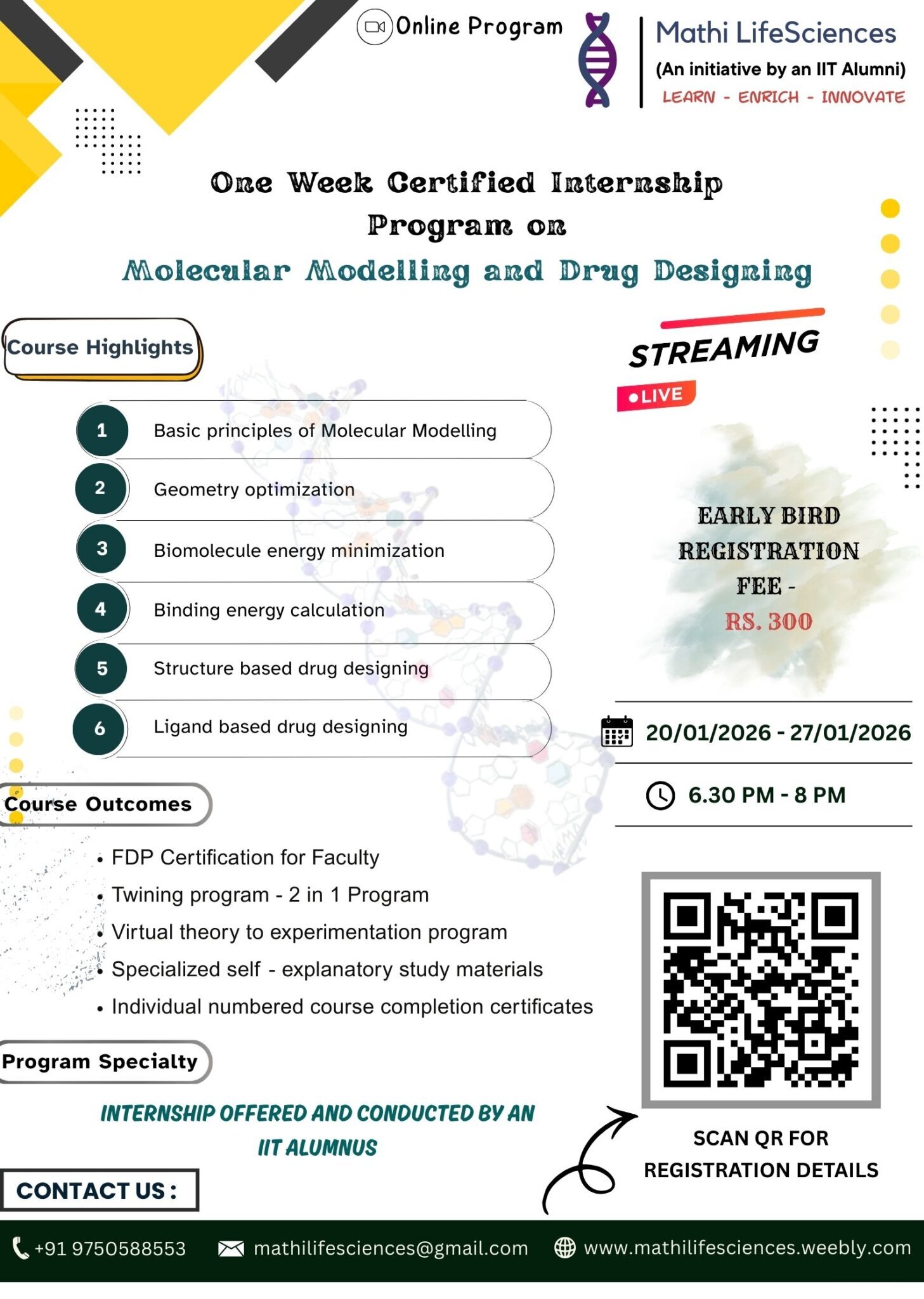
    </dd></dl><figure><img src="https://cdn.indiabioscience.org/media/yim/MD-DD-Jan-26.jpg" data-image="822961"></figure>
              ]]></content><category term="other" label="Other" /><category term="online" label="Online" /></entry><entry><title>National Seminar on Recent Influences of Quantum Technologies and Artificial Intelligence in Biotechnology (NS–QTAIB 2026)</title><link
                  rel="alternate"
                  href="https://indiabioscience.org/events/national-seminar-on-recent-influences-of-quantum-technologies-and-artificial-intelligence-in-biotechnology-ns-qtaib-2026"
                  type="text/html"
                  /><summary type="html"><![CDATA[
                
<em>
  Seminar
</em>
from
<time>
  29 January
</time>
  to
  <time>
    30 January 2026
  </time>
at
Chennai.
              ]]></summary><id>tag:indiabioscience.org,2025-12-15:/events/national-seminar-on-recent-influences-of-quantum-technologies-and-artificial-intelligence-in-biotechnology-ns-qtaib-2026</id><published>2025-12-15T14:02:00+05:30</published><updated>2025-12-15T14:44:43+05:30</updated><content type="html"><![CDATA[
                
<dl><dt>
    Date
  </dt><dd><time datetime="2026-01-29">
      January 29</time><time datetime="2026-01-30">-30, 2026
      </time></dd><dt>
      Location
    </dt><dd>
      Chennai, Tamil Nadu
    </dd><dt>Website</dt><dd><a
        href="https://sites.google.com/view/www-ncaqb2026-com/home">
        sites.google.com/view/www-ncaq… &rarr;
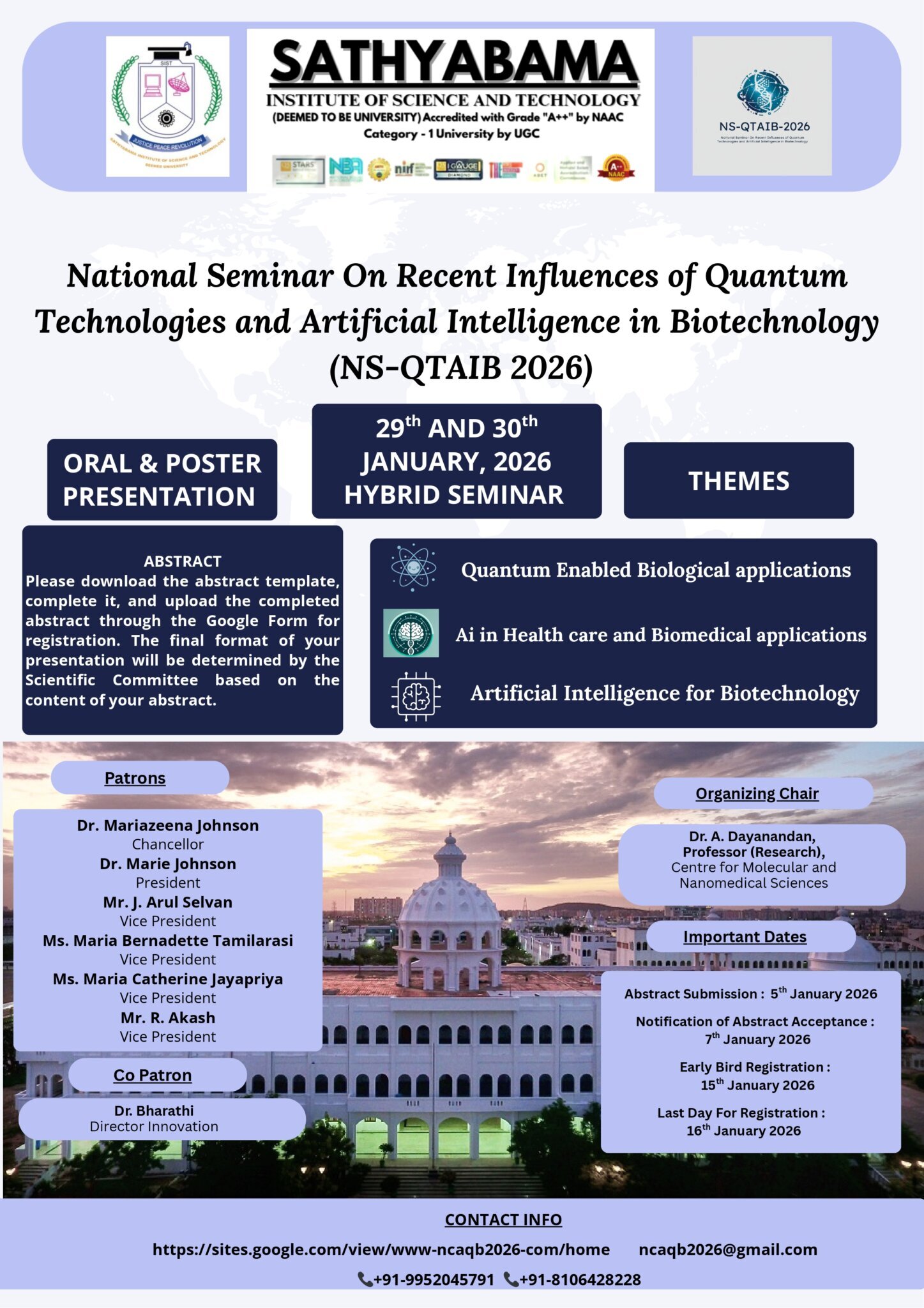
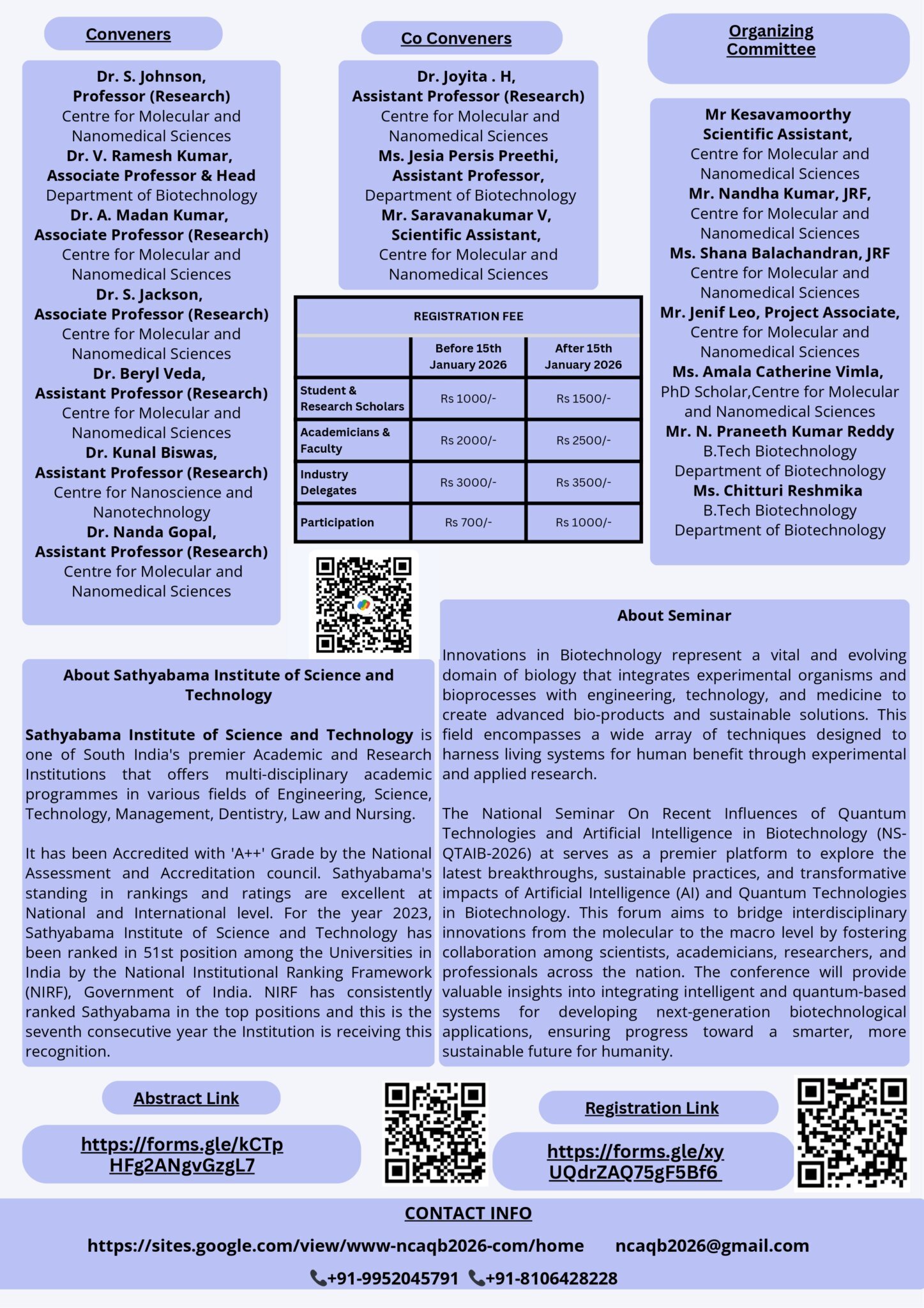
      </a></dd></dl><p>Sathyabama Institute of Science and Technology is organising a National Seminar on Recent Influences of Quantum Technologies and Artificial Intelligence in Biotechnology (NS–QTAIB 2026), scheduled to be held on 29th and 30th January 2026 in hybrid mode.</p><p>The seminar focuses on cutting-edge themes including Quantum-enabled Biological Applications, Artificial Intelligence for Biotechnology, and AI in Healthcare &amp; Biomedical Applications. This event aims to bring together researchers, academicians, industry professionals, and students from across the country to share insights and present innovative findings.</p><figure><img src="https://cdn.indiabioscience.org/media/yim/Seminar-2026-Broucher-final-5-2_page-0001.jpg" data-image="822945"></figure><figure><img src="https://cdn.indiabioscience.org/media/yim/Seminar-2026-Broucher-final-5-2_page-0002.jpg" data-image="822947"></figure>
              ]]></content><category term="seminar" label="Seminar" /><category term="chennai" label="Chennai" /></entry><entry><title>EVOLVE 2026</title><link
                  rel="alternate"
                  href="https://indiabioscience.org/events/evolve-2026"
                  type="text/html"
                  /><summary type="html"><![CDATA[
                
<em>
  Conference
</em>
from
<time>
  02 April
</time>
  to
  <time>
    04 April 2026
  </time>
at
Odisha.
              ]]></summary><id>tag:indiabioscience.org,2025-12-12:/events/evolve-2026</id><published>2025-12-12T17:27:00+05:30</published><updated>2025-12-12T17:27:57+05:30</updated><content type="html"><![CDATA[
                
<dl><dt>
    Date
  </dt><dd><time datetime="2026-04-02">
      April 02</time><time datetime="2026-04-04">-04, 2026
      </time></dd><dt>
      Location
    </dt><dd>
      Odisha, India
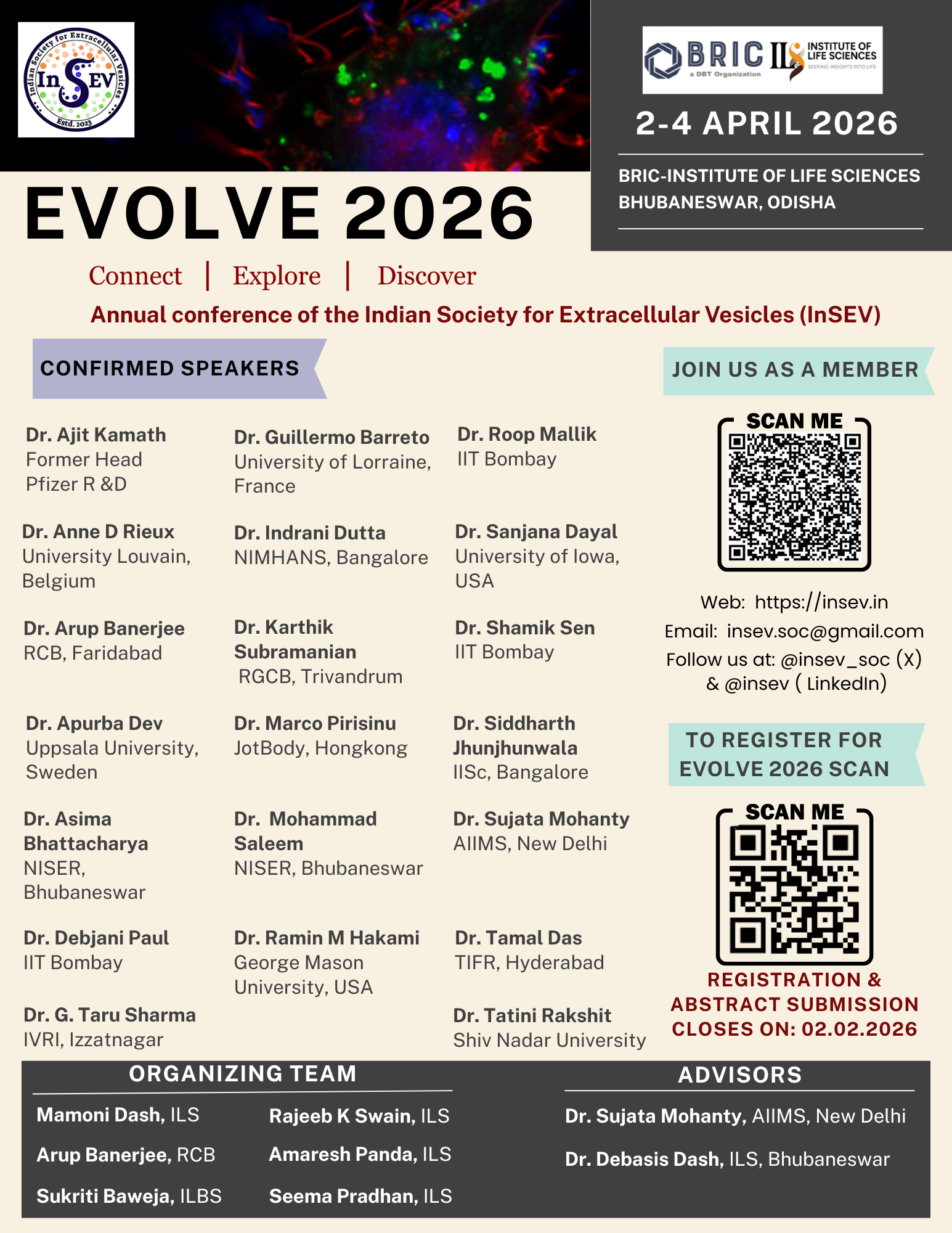
    </dd></dl><p>The Annual Conference of the Indian Society for Extracellular Vesicle (<a href="https://insev.in/" target="_blank" rel="noreferrer noopener">InSEV</a>), EVOLVE - 2026 (April 02 - 04, 2026), is convened to provide a distinguished platform for researchers, clinicians, and industry experts engaged in the study and application of extracellular vesicles. The conference seeks to foster the exchange of cutting-edge knowledge and promote meaningful collaborations that advance both the fundamental understanding and translational potential of EV science.</p><p>A central objective of the conference is to bring together researchers investigating various dimensions of EV biology. By emphasising cross-disciplinary collaboration, the meeting aims to integrate expertise from diverse fields, including cell and molecular biology, nanotechnology, omics sciences, and clinical research, thereby creating a conducive platform for innovation and translational discovery.</p><figure><img src="https://cdn.indiabioscience.org/media/yim/EVOLVE-Rg-Flyer-1.png" data-image="822857"></figure>
              ]]></content><category term="conference" label="Conference" /><category term="odisha" label="Odisha" /></entry><entry><title>Microbiology, Molecular Biology, Cell Cultural &amp; Soft Skills</title><link
                  rel="alternate"
                  href="https://indiabioscience.org/events/microbiology-molecular-biology-cell-cultural-soft-skills"
                  type="text/html"
                  /><summary type="html"><![CDATA[
                
<em>
  Other
</em>
on
<time>
  19 January 2026
</time>
at
Hyderabad.
              ]]></summary><id>tag:indiabioscience.org,2025-12-08:/events/microbiology-molecular-biology-cell-cultural-soft-skills</id><published>2025-12-08T10:56:00+05:30</published><updated>2025-12-08T19:36:07+05:30</updated><content type="html"><![CDATA[
                
<dl><dt>
    Date
  </dt><dd><time datetime="2026-01-19">
      January 19, 2026</time></dd><dt>
      Location
    </dt><dd>
      Hyderabad, Telangana
    </dd><dt>Website</dt><dd><a
        href="http://www.biofaba.org.in">
        www.biofaba.org.in &rarr;
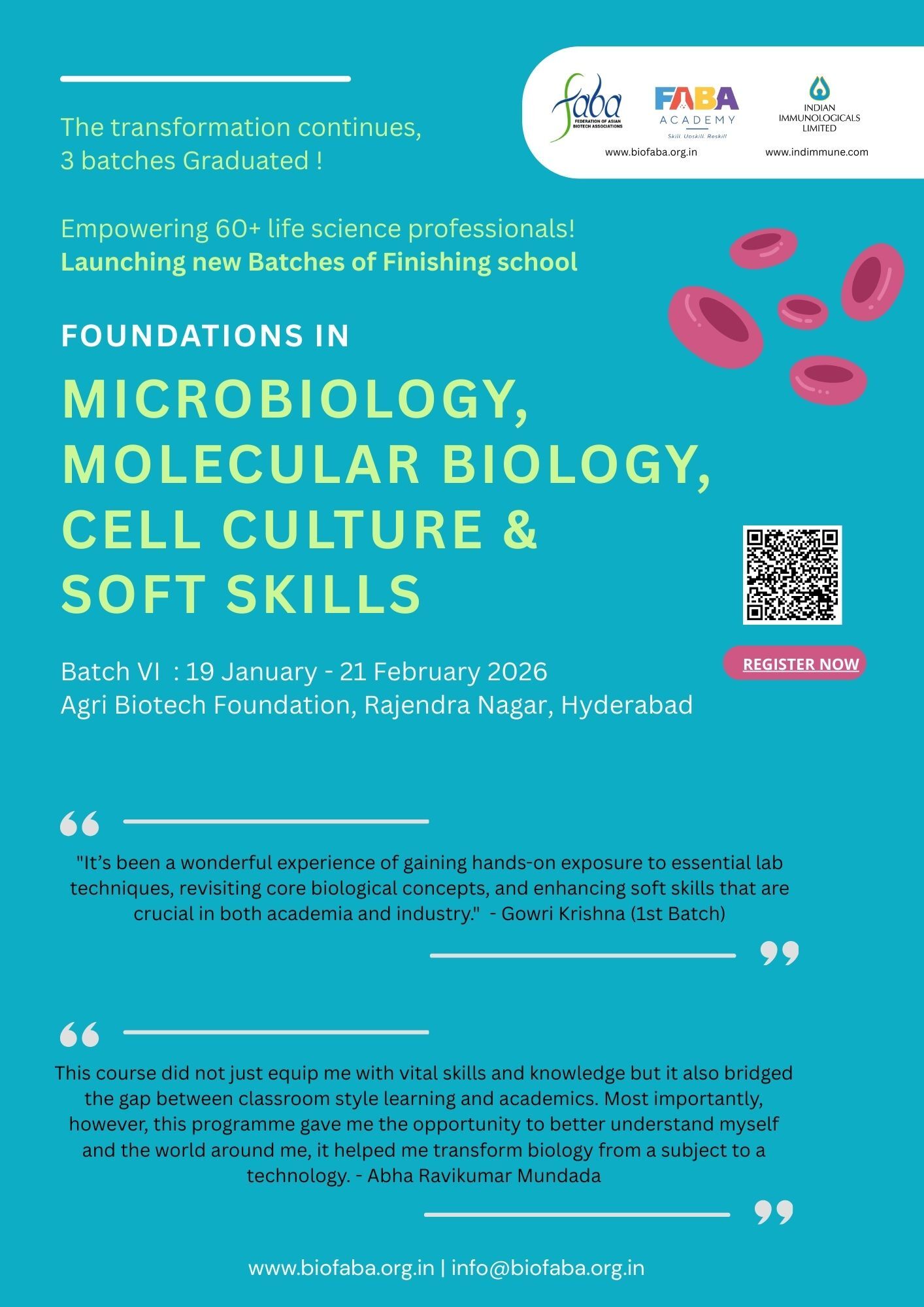
      </a></dd></dl><p>This intensive one-month course provides a comprehensive introduction to the fundamentals of microbiology, molecular biology, and cell culture techniques along with soft skills needed to job market. Through a combination of lectures, handson laboratory sessions, and interactive discussions, participants will gain a solid theoretical understanding and practical skills in these essential areas of life sciences. WHY CHOOSE THIS PROGRAM?</p><ul><li>Comprehensive curriculum covering microbiology, molecular biology, and cell culture</li><li>Hands-on laboratory experience with cutting-edge techniques and equipment</li><li>Career development through professional soft skills training</li><li>Expert instruction from experienced faculty members</li><li>Industry-relevant skills that enhance employability</li><li>Networking opportunities with professionals in the field</li></ul><figure><img src="https://cdn.indiabioscience.org/media/yim/Finishing-School-Batch-6.jpg" data-image="822619"></figure>
              ]]></content><category term="other" label="Other" /><category term="hyderabad" label="Hyderabad" /></entry></feed>